Planets

Mosaic of images taken by the Mars Rover Curiosity (Image NASA/JPL-Caltech)

The Mars Rover Curiosity started using for the first time its software for the autonomous navigation, or autonav. It allows the rover to decide on its own where to go while maintaining its security. In this case, when it uses it it will decide which detours it will take to get to Mount Sharp, the final destination of its mission.
During this month, the Mars Rover Curiosity has also kept on taking photographs not only of Mars but also of its sky. In particular, on August 17 it used its Mast Camera (MastCam) to take a series of photographs of a solar eclipse in which Phobos, one of Mars’ two moons, has moved completely in front of the Sun.

Exactly one year ago, one Earth year to be precise, the Mars Rover Curiosity landed on Mars. During what were called seven minutes of terror the complex landing system used for the first time brought the largest and most sophisticated robot sent so far on the red planet to its surface.

Artistic concept of the planet HD 189733b transiting its star. The small insert shows The star HD 189733 A with its companion HD 189733 B and another externa object seen by the Chandra space telescope (Image X-ray: NASA/CXC/SAO/K. Poppenhaeger et al; Illustration: NASA/CXC/M. Weiss)

The Chandra X-ray space telescope was used for the first time to detect the presence of an exoplanet. This is not a discovery because the planet in question is HD 189733b, more formally HD 189733 Ab, which was already in the spotlight a few weeks ago because the observations made with the Hubble Space Telescope established that its color is blue.

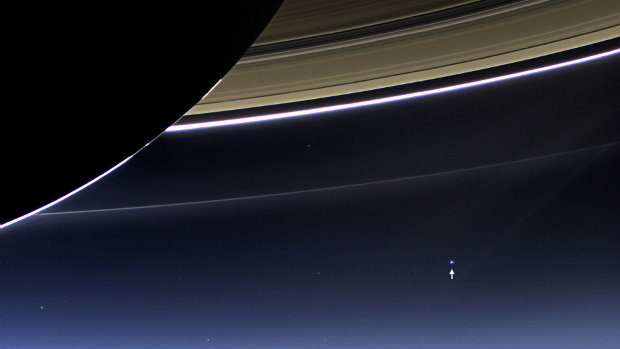
Earth and Moon seen as a single dot from Saturn in a picture taken by the Cassini space probe (Photo NASA/JPL-Caltech/Space Science Institute)

A few days ago, NASA announced that on July 19 the Cassini spacecraft was taking a picture of the Earth and the Moon from Saturn’s orbit. On that occasion the agency also launched an initiative inviting people to wave at Cassini and it’s estimated that more than 20,000 people participated. Obviously, from a distance of nearly a 1,5 billion kilometers (about 900 million miles) the Earth is just a dot but it was a symbolic gesture. Almost simultaneously, the MESSENGER spacecraft took a similar picture but from Mercury’s orbit.

The measurements taken by the Sample Analysis at Mars (SAM) instrument of the Mars Rover Curiosity have provided evidence about the collapse of the ancient Martian atmosphere. The conclusions of the analysis of these data confirm that in the past the red planet had an atmosphere similar to that of Earth, much denser than at present. About 4 billion years ago, most of the Martian atmosphere dissipated in space.