
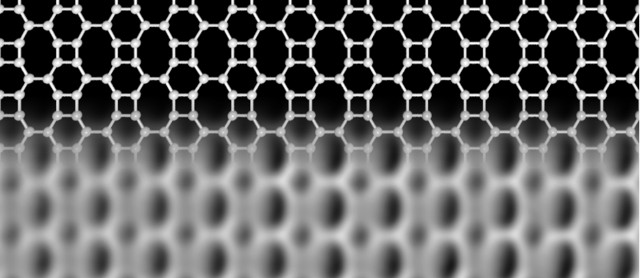
An article published in the journal “Science” reports the production of sheets as thick as one atom of biphenylene, also confirming that the material has metallic properties, a feature that was theorized but not proven so far. A team of researchers created an ordered lattice made up of squares, hexagons, and octagons. This structure reminds in various ways graphene sheets, a material that for years has been considered very interesting for many possible applications but is still complex to produce at an industrial level at low costs. For some applications, such as an anode material in lithium-ion batteries, biphenylene networks might be better than graphene.
The new material’s network sheets were obtained by exploiting specific chemical reactions that lead carbon-containing molecules to form a regular structure on an extremely smooth gold surface. A series of reactions generate the structure in which squares, hexagons, and octagons are combined to generate a material with very interesting characteristics. The image (Courtesy University of Marburg and Aalto University. All rights reserved) shows in the upper part a representation of the biphenylene network’s structure and in the lower part the same structure as it actually appears when it’s observed under the microscope.
In recent years, graphene has received a lot of attention due to the great potential that its characteristics offer to obtain developments that are considered revolutionary in the field of electronics. In practice, these developments are slow due to the difficulties in generating high-quality graphene sheets at a low cost. To exploit the properties of carbon, someone studied other materials such as biphenylene with interesting results.
Professor Michael Gottfried of the University of Marburg, Germany, who led the team that developed the process to create the biphenylene network, explained that strips of this network only 21 atoms wide behave like a metal while graphene at that size is a semiconductor. This means that wires of this new material can be used as conductors for future carbon-based electronic instruments. As an anodic material in lithium-ion batteries, it may be better than graphene itself.
Moving from the laboratory to the factory is a huge step, so we’ll have to see the developments in the production of biphenylene network sheets. The researchers intend to continue studying their production to improve it and produce larger sheets. Professor Peter Liljeroth of Aalto University, another of the authors of this study, is confident that the new synthesis method could lead to the discovery of more new carbon networks. They’re very interesting studies but it’s essential that they’re transformed into practical applications to be something more than scientific curiosities.
