
An article published in the journal “eLife” reports the development of an approach based on convolutional neural networks (CNNs) to identify genes inherited from other species such as Neanderthals that brought positive effects. A team of researchers led by Graham Gower of the Danish University of Copenhagen developed this deep learning technique to examine genomes of modern humans for examples of what is technically called introgression, which means genes that a hybrid between two species brought into one of his parents’ species. Various possible examples have been found, for example, genes inherited from Denisovans have been found in Melanesians that affect various metabolic and disease-related traits.
The progress of genetic analysis techniques, including those related to the study of extinct species, called paleogenetics, led to the discovery of a complex history of humanity. Over the course of who knows how many millennia, various populations of modern humans, especially non-Africans, crossbred with other species of hominins. In particular, crossbreedings with Neanderthals have already been the subject of various studies thanks to the availability of various more or less complete genomes of individuals belonging to this species. Other studies involved the mysterious Denisovans, of which only a few bones have been found, almost all of them in Siberia, where the excellent preservation conditions made it possible to obtain many DNA fragments.
The consequences of spreading the genes of other hominins in populations of modern humans are varied, and studies on them are only just beginning. Some genes may have brought advantages so this type of study also has very practical reasons, as they’re also important on a medical level. This is really complex research, and the authors of this new research resorted to very sophisticated technologies.
Neural networks are used more and more in the field of bioinformatics, which uses computers to tackle biological problems, for the possibility of training a system, in this case, to recognize certain genes. In artificial intelligence branches such as machine learning and deep learning, there are various types of neural networks and in this case, a convolutional neural network (CNN) has been used.
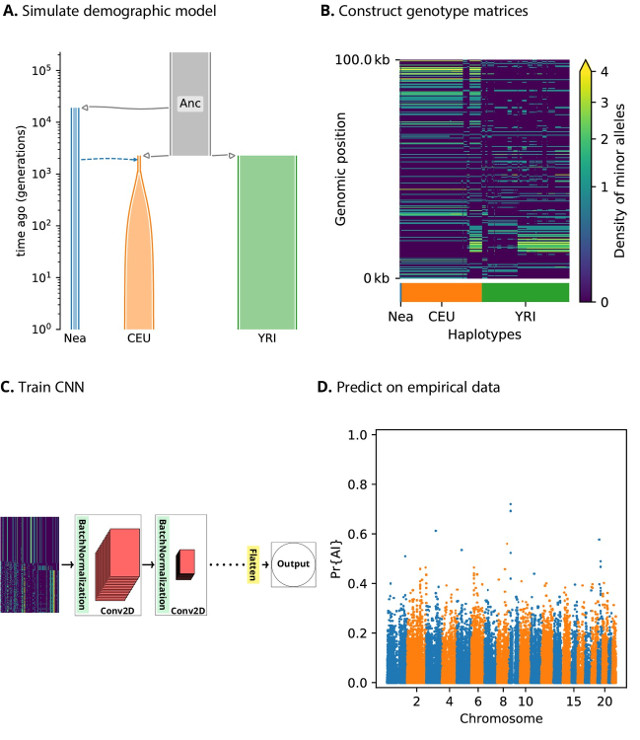
The image (Courtesy Gower et. al. All rights reserved) shows a schematic of how the system called genomatnn recognizes adaptive introgression, the type that brings positive effects. They start with a demographic history simulation (A) which includes introgression by simulating three scenarios. The triple sequence is converted into a genotype matrix to be supplied to the convolutional neural network (B). Thousands of simulations are produced for each scenario and genotype arrays are used to train the neural network (C). The training provides the probability that a matrix matches an adaptive introgression and eventually, the trained neural network is applied to a genotype matrix drawn from a database (D).
According to Graham Gower, genomatnn offers more accurate results than previous approaches. His team applied it to various human genomic databases and found several candidate genes resulting from an adaptive introgression. Some of them had already been found before and this shows that the new approach works. Other genes had never been described.
Some genes inherited from Neanderthals have been discovered in genomes of Europeans that influence blood-related phenotypes. An interesting discovery concerns genes present in Melanesians that were inherited from the Denisovans that affect various metabolic traits and others related to protection from various diseases.
The effects of the various genes deriving from introgression will also be studied at a medical level. In the case of genes that protect against tumors, this could offer important information that could help develop therapies that stimulate the body to suppress tumors.
Graham Gower’s team will continue their work to also search for genes from extinct populations such as other hominins whose DNA is not available. These are complex studies that exploit increasingly advanced technologies to better understand the history of humanity and, in this case, also to improve the health of today’s humans.
