2013

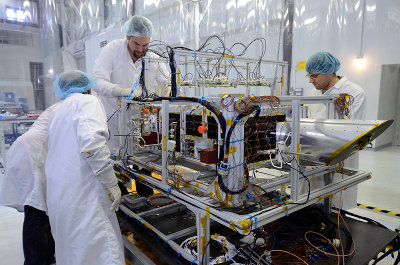
The NEOSSat satellite while being prepared for a test (Photo courtesy Janice Lang, DRDC)

A Polar Satellite Launch Vehicle (PSLV) rocket has just been launched from the Satish Dhawan Space Center on Sriharikota island, India. The cargo includes a series of small satellites including some nanosatellites such as the Surrey Training, Research and Nanosatellite Demonstrator (STRaND-1), based on a Google Nexus 1 smartphone running Android. Among the “real” satellites there’s the NEOSSat (the Near-Earth Object Surveillance Satellite). A little more than 20 minutes after the launch, the satellites have been deployed into orbit successfully.

The National Center for Supercomputing Applications (NCSA) gifted the Institute for Genomic Biology (IGB) at the University of Illinois at Urbana-Champaign the supercomputer Ember. Originally funded by the National Science Foundation (NSF), it will now be used to work in genomics and transcriptomics. It will be handled by the High-Performance Biological Computing (HPCBio) group, which runs the infrastructure for bioinformatics.

A comparison of the size of the planets of the Kepler-37 system with the Moon, Mercury, Mars and the Earth (Image NASA/Ames/JPL-Caltech)

A group of scientists working at the mission of the Kepler space telescope announced that they discovered a new planetary system orbiting the star Kepler-37. So far nothing new considering that this kind of news is coming on a daily basis but this time they discovered a very small planet because Kepler-37b is slightly larger than the Moon.

On February 22, 1993 in the U.S.A. “The Gathering” was broadcast, the TV movie pilot that introduced the saga of “Babylon 5”, created by J. Michael Straczynski.

In 2257, “Babylon 5” is a space station built in a neutral space to be a place for diplomatic and commercial meetings between a multitude of sentient species.

In April 2012, Google introduced Google Glass, augmented reality glasses. Now the time arrived to open the pre-orders for the first commercial version called Explorer Edition, at the cost already planned of $1,500. For common users it will take a long time before they can buy them, howver there’s the possibility to become an Explorer, meaning being part of a group of “pioneers” who will participate in the Google Glass launch events in New York, San Francisco and Los Angeles.