May 2016

Rama II by Arthur C. Clarke and Gentry Lee

The novel “Rama II” by Arthur C. Clarke and Gentry Lee was published for the first time in 1989. It’s the sequel of “Rendezvous with Rama”.

Seventy years after the passage of the alien spaceship called Rama, another one that looks identical gets spotted. Despite the terrible global economic crisis of the previous decades led to sharp cuts in space exploration, an expedition is set up to go and try to find out the secrets of what gets called Rama II.

The Rama II exploration mission’s crew members are supposed to be professionals focused on scientific research. Instead, some of them show soon they have secret agendas and ambitions that interfere with the research. Some events that may or may not be accidents further threaten the expedition.

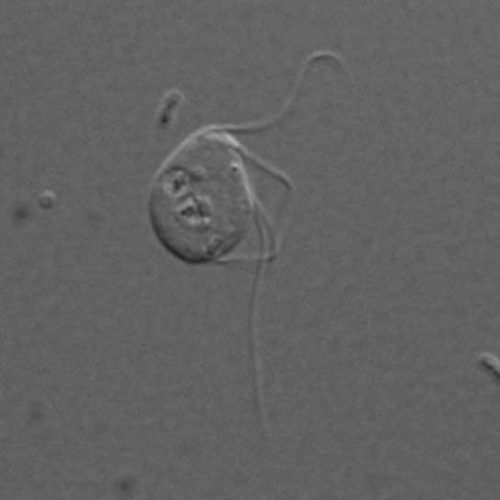
Light micrograph of Monocercomonoides sp. PA203 (Image courtesy Dr. Naoji Yubuki)

An article published in the journal “Current Biology” describes a research of one genus of protists called Monocercomonoides. A team led by Anna Karnkowska, now at the University of British Columbia in Vancouver, Canada, sequenced the genome of a species that belong to that genus. The result was surprising because it’s a eukaryotic but has no mitochondria, the first case of this kind ever discovered.

Mosasaurus hoffmannii skeleton

An article published in the journal “Palaeontology” describes a research which concluded that mosasaurs were warm-blooded. These animals were marine reptiles that became extinct along with the dinosaurs about 66 million years ago, at the end of the Cretaceous period. Dr. Alberto Perez-Huerta, a professor of geology at the University of Alabama, and then students T. Lynn Harrell Jr. and Celina Suarez believe they have found evidence that mosasaurs were warm-blooded and not cold-blooded, like other scientists claimed.

The skulls of Atopodentatus Unicus found in 2016 (Image W. Gao, Institute of Vertebrate Paleontology and Paleoanthropology)

An article published in the journal “Science Advances” describes the analysis of fossils of Atopodentatus unicus, a reptile that lived in the mid-Triassic period, between 247 and 242 million years ago. Recent discoveries of two fossil skulls forced palaeontologists to rethink the idea they had made of this animal and now they consider it the most ancient herbivore marine reptile discovered so far.

The Strange Invaders by Alun Llewellyn (Italian edition)

The novel “The Strange Invaders” by Alun Llewellyn was published for the first time in 1934.

The caravan that must bring supplies is late and, while waiting to see it on the horizon, Adun thinks about Erya, a girl he likes. Unfortunately Karasoin, the head of the House of Swords, noticed her beauty as well and he has a lot more consideration than Adun among the Fathers.

The situation gets worse with the arrival of a horde of Tartars. They claim that they are not looking for a city to plunder but are fleeing monsters. The Fathers don’t believe those stories because in their doctrine there is no mention of these monsters and rely on the Faith in the trinity of Marx, Lenin and Stalin.