September 2018

Artist's impression of Jurassic seas (Image courtesy Nikolay Zverkov. All rights reserved)

An article published in the journal “Nature Ecology & Evolution” describes a study on marine reptiles that lived in a sea area that crossed today’s northern Europe called Jurassic Sub-Boreal Seaway during the Jurassic period. A team of paleontologists coordinated by the University of Edinburgh analyzed the shape and size of teeth that belonged to reptile that lived over a period of 18 million years, discovering that the marine predators living in deep waters prospered when sea levels rose while species they lived in shallow waters declined or even became extinct.

Kayentatherium wellesi adult with its babies (Image courtesy Eva Hoffman / The University of Texas at Austin)

An article published in the journal “Nature” describes a research on the origin and evolution of mammals’ great brains. Eva Hoffman and Timothy Rowe of the University of Texas at Austin’s Jackson School of Geosciences examined fossils of Kayentatherium wellesi, a relative of today’s mammals that lived in the Jurassic period, concluding that a key moment in their evolution was a kind of trading brood power for brain power.

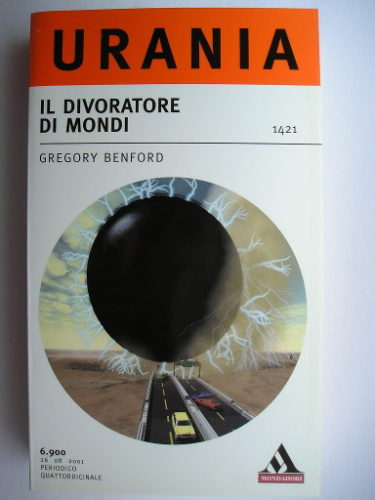
Eater by Gregory Benford (Italian edition)

The novel “Eater” by Gregory Benford was published for the first time in 2000.

Some astronomers are trying to understand the nature of a strange cosmic phenomenon. Two gamma-ray bursts a few hours apart seem to suggest different origins but it turns out to have been generated by a tiny black hole that’s entering the solar system devouring everything it meets.

The attention of Benjamin Knowlton, one of the astronomers, is divided between this enigma and his wife Channing, gravely ill with cancer. Despite this, he and his colleague Kingsley Dart must try to predict the trajectory of that black hole devourer and studying it they discover that it’s even stranger than they thought.

The study of the theropod dinosaurs found in the Ellisdale site offers new data on their ecology in the Cretaceous

An article published in the “Journal of Paleontology” describes a research on the theropod dinosaurs whose fossils date back to the Late Cretaceous and were found at the site of Ellisdale, in New Jersey, USA. Chase Brownstein of the Stamford Museum and Nature Center studied fossils belonging to various families: adrosauroids (Hadrosauroidea), tyrannosaurids (Tyrannosauridae), dromaeosaurids (Dromaeosauridae) and ornithomimosaurs (Ornithomimosauria). The Ellisdale site is sometimes overlooked but these findings can provide information on the diversification of theropods throughout North America.