2019

Aegicetus gehennae was a whale with legs that lived 35 million years ago

An article published in the journal “PLOS ONE” reports the identification of an ancient species of whale that was named Aegicetus gehennae. It lived about 35 million years ago, in the Eocene period, in an area that is now occupied by the Egyptian desert. A team of paleontologists examined a skeleton that’s exceptionally complete for this type of animal and a second partial skeleton concluding that it was a species belonging to the protocetid family, cetaceans that were probably amphibians. This new species represents an intermediate stage between the most primitive whales, which used using their feet to swim, and the modern ones that swim using their tail, providing information on their evolution.

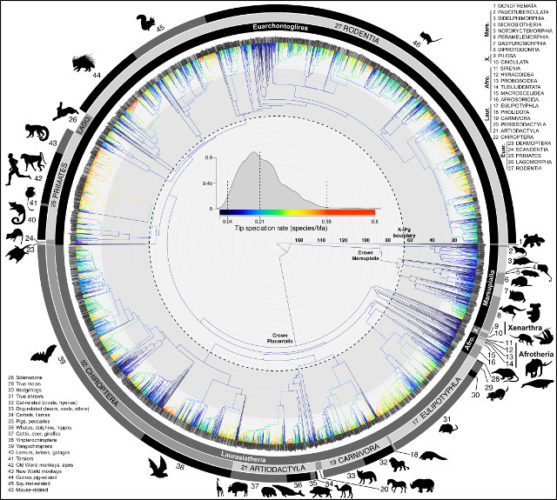
A new family tree of mammals to reconstruct their history and relationships

An article published in the journal “PLOS Biology” reports an analysis of the information available on the relationships among mammal species that aims to build an evolutionary family tree of this group of animals. Nathan Upham and Walter Jetz of Yale University together with Jacob Esselstyn of Louisiana State University used data on fossils and genomics to try to analyze at phylogenetic level the evolution of the various branches within the mammal taxonomic class. Understanding their relationships offers information on their history and biodiversity, a crucial step for environmental conservation.

The Wind from Nowhere by J.G. Ballard

The novel “The Wind from Nowhere” by J.G. Ballard was published for the first time in 1961 in two parts in the magazine “New Worlds Science Fiction” and in 1962 as a book.

When Dr. Donald Maitland returns home to his wife after finishing a job, he realizes that the wind is reaching an extraordinary force. What appears to be an anomalous event is just the beginning of a global phenomenon because all over the world the wind starts being so strong that it has increasingly destructive effects.

The British authorities are trying to set up a response to the growing danger of the wind but the only solution that appears viable around the world seems to move the survivors underground. The only exception is the construction of a pyramid strong enough to support the power of a wind that’s as destructive as none ever before.

René Auberjonois in 2013

The actor René Auberjonois passed away yesterday, December 8, 2019, due to lung cancer. René Murat Auberjonois was born on June 1, 1940 in New York, USA, to a family with a complex family tree whose ancestors included the royals of Naples Gioacchino Murat and Carolina Bonaparte, Napoleon’s younger sister.

René Auberjonois’ cinema career began with a couple of roles as an extra artist and then got his first major role in the 1970 movie “M*A*S*H” and work again with director Robert Altman in the movies “Brewster McCloud” (1970) and “McCabe & Mrs. Miller” (1971). On television he was a guest star on several TV shows during the 1970s but his first major role came when he joined the cast of the TV show “Benson” in its second season to stay there until its seventh and last season.

René Auberjonois joined the universe of Star Trek with a little role in the 1991 movie “Star Trek VI: The Undiscovered Country” but is really known for the role of shapeshifter Odo in the TV show “Star Trek: Deep Space Nine”.

In the last decade René Auberjonois played a regular character in the TV show “Boston Legal” and kept on being very active in productions of different types, also working as a narrator of documentaries. These activities continued into this decade as well, showing how eclectic he was.

Some meteorite NWA 1172's dust fragments colonized by Metallosphaera sedula (Image courtesy Tetyana Milojevic)

An article published in the journal “Scientific Reports” describes a study on the ability of a species of archaea called Metallosphaera sedula to grow into typical meteorite materials using the metals they contain as an energy source. A team of researchers led by astrobiologist Tetyana Milojevic of the University of Vienna examined these archaea living and interacting with a real meteorite. The results can provide clues to the origin of life on Earth thanks to the possibility of identifying with greater certainty microfossils containing metals. This also means having better chances of evaluating possible traces of microscopic life found in other places in the solar system.