2019

A skull of the herbivorous dinosaur called Styracosaurus albertensis shows that it had asymmetrical horns

An article published in the journal “Cretaceous Research” reports a study of a fossil skull of Styracosaurus albertensis, a herbivorous dinosaur that lived in today’s North America about 75 million years ago, in the Cretaceous period. A team of researchers led by Professor Robert Holmes of the University of Alberta, Canada, examined this well-preserved fossil noting that its horns were asymmetrical. Previously, no skull attributed to the genus Styracosaurus was complete enough to see that asymmetry. This discovery could lead to various reclassifications of fossils that over time were attributed to other species of the genus Styracosaurus and later even to other genera.

The Delirium Brief by Charles Stross

The novel “The Delirium Brief” by Charles Stross was published for the first time in 2017. It’s part of the Laundry series and follows “The Nightmare Stacks”.

The Laundry came out considerably weakened from the sequence of crisis in which it was involved and the invasion attempt from another dimension made its existence public. On a political level, this turned the agency into a scapegoat for all the recent dramatic events that couldn’t be covered up.

The British government plans to shut down the Laundry but the need for an agency capable of handling threats and events linked to magic is now clear. The alleged greater efficiency of specialized companies makes the idea of ​​contracting such services attractive but the only real candidate represents the main threat to the Kingdom. That forces the surviving Laundry senior members to adopt emergency measures, even extreme ones.

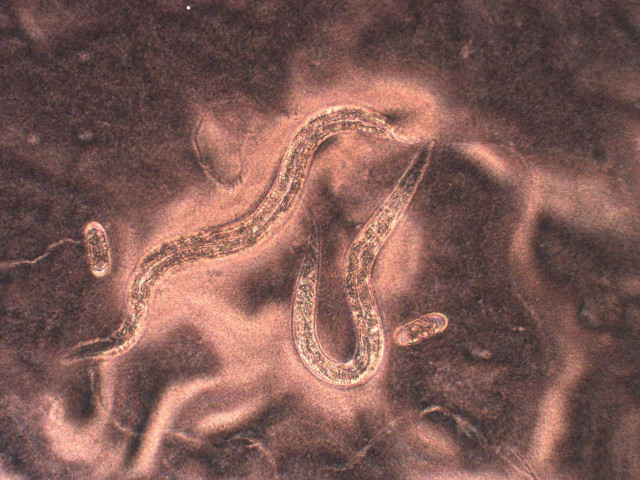
Halicephalobus mephisto (Image courtesy John Bracht, American University)

An article published in the journal “Nature Communications” reports the DNA sequencing of a nematode nicknamed “Devil Worm” whose scientific name is Halicephalobus mephisto. A team of researchers led by Dr. John Bracht of the American University sequenced the DNA of this worm only half a millimeter long to try to understand the genetic reasons behind its ability to live even at over 3 kilometers deep underground in warm water veins, where there’s little oxygen and a large amount of methane. An article published in the “Journal of Molecular Evolution” reports the examination of some genes that this nematode has in common with some molluscs adapted to live in warm environments.

New fossils of an ancient legged snake called Najash rionegrina offer new information on the evolution of snakes

An article published in the journal “Science Advances” reports the study of new fossils of a snake belonging to the species Najash rionegrina, which lived in the Cretaceous period, between 90 and 100 million years, in today’s Patagonia, Argentina. A team of researchers led by Fernando Garberoglio of the Fundación Azara at Universidad Maimónides in Buenos Aires, Argentina, subjected various fossils belonging to this species, which had well-developed limbs, to a high-resolution CT scan to obtain new information on the evolution of snakes.

Edwin Hubble

Edwin Power Hubble was born on November 20, 1889 in Marshfield, Missouri, USA. The observations he made allowed him to find cepheid variable stars, which could be used to calculate the distances of the nebulae that host them and to prove that they were outside the Milky Way, contradicting the theory that was then more highly regarded. Other studies by Edwin Hubble concerned galaxies’ redshift.