June 2023

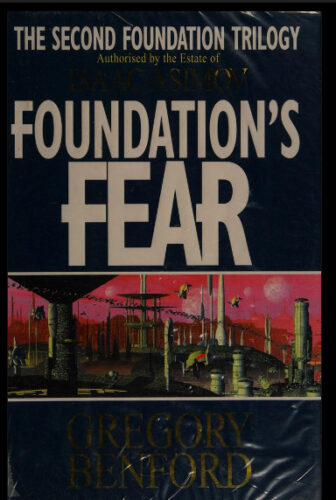
Foundation's Fear by Gregory Benford

The novel “Foundation’s Fear” by Gregory Benford was published for the first time in 1997. It’s the first book of the so-called second Foundation trilogy.

Emperor Cleon I intends to appoint Hari Seldon as Prime Minister but the political situation is complicated. The imperial choice is due to the belief that the psychohistory that Seldon is developing can help the Galactic Empire. Betan Lamurk, a member of the Imperial Council, has his own ambitions and is ready to do anything to eliminate Seldon.

One controversy among the populace concerns artificial identities. Simulations of Voltaire and Joan of Arc are used to explore different positions on the nature of artificial identities but their activity ends up taking unexpected turns.

A reconstruction of a Homo naledi skeleton in the position in which it was found (Image courtesy Berger et al., 2023)

Three articles under peer review ahead of a publication in the journal “eLife” report different aspects of a study of what were defined as intentional burials of individuals belonging to the species Homo naledi. Various researchers including Dr. Lee Berger, who led the team that discovered these hominins, examined the cave called Rising Star, about 50 km northwest of Johannesburg, South Africa, in which their fossils were discovered and what were interpreted as engravings of symbols accompanying those burials. This would mean that Homo naledi buried their dead between 241,000 and 335,000 years ago, 100,000 years before Homo sapiens.

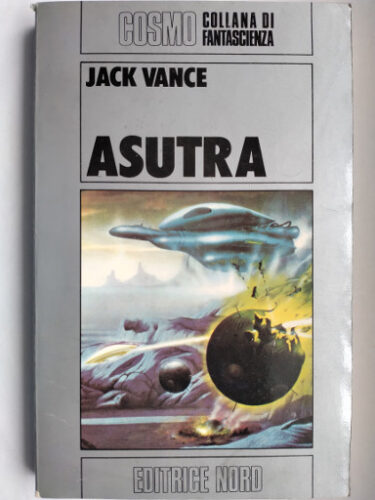
The Asutra by Jack Vance

The novel “The Asutra” by Jack Vance was published for the first time in 1973 serialized in “The Magazine of Fantasy and Science Fiction” and in 1974 as a book. It’s the third book in the Durdane trilogy and follows “The Brave Free Men”.

Gastel Etzwane left the government of Durdane to devote himself to music but it seems that the problem of the Roguskhoi, the creatures that brought terror in many areas of Durdane, hasn’t been completely solved. Rumors suggest that the Roguskhoi appeared on the continent of Caraz and it’s necessary to verify their connection with the mysterious Asutra.

A new encounter with the earthling Ifness offers new information to Gastel Etzwane and the two men decide to go on a journey to solve all the mysteries. Rumors of sightings of alien spaceships above Caraz could be linked to the Asutra and Etzwane is determined to go all the way to find the truth while Ifness intends to act only through his official channels.

A schematic of the various evolutionary patterns of Homo sapiens including also an interbreeding with Neanderthals

An article published in the journal “Nature” reports a study that relaunches the idea that the Homo sapiens species emerged not from a single population that had e linear evolution but from different groups of genetically similar hominins that diversified and then interbred again. A team of researchers led by Brenna Henn of the University of California-Davis, USA, and Simon Gravel of McGill University in Montreal, Canada, conducted a genetic analysis and a comparison with early Homo sapiens fossils to try and locate the origin of modern humans. The researchers tested different evolutionary and migratory models and the one that best matches the data points to ramifications of African populations that subsequently interbred again until they merged.