
August 2026

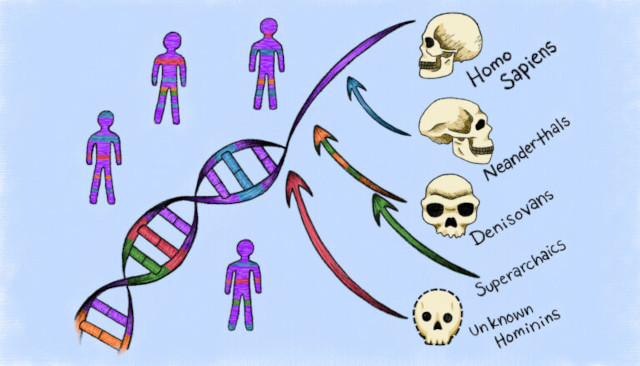
A diagram indicating the hominins that have left genetic traces in the DNA of modern humans.

An article published in the journal “Science” reports the discovery of genes belonging to two previously unknown hominin species in the DNA of modern humans. A team of researchers led by the University of California, Berkeley used a new algorithm called TRACE (TRacking Archaic Contributions via ARG Estimation), which they developed to reconstruct genetic relationships among hundreds of living human genomes. This allowed them to recognize two archaic genetic components from hominins that interbred with Homo sapiens in Africa over 50,000 years ago, and another from an interbreeding that occurred approximately 1.8 million years ago. The super-archaic genes of the second group don’t derive from a different interbreeding with modern humans, but from an interbreeding with the Denisovans.

Camp Concentration by Thomas M. Disch

The novel “Camp Concentration” by Thomas M. Disch was published for the first time in 1967, serialized in the magazine “New Worlds” and later as a book.

Louis Sacchetti was imprisoned as a conscientious objector who refused to participate in the war that had pitted the United States against virtually the entire world. Even in that situation, he tried to continue writing poetry, but after some time, he was transferred to a secret facility run by the military.

In his new prison, Louis Sacchetti discovers he was transferred to Camp Archimedes, where he becomes part of an intelligence-enhancement experiment. After being interviewed by resident psychiatrist Aimee Busk, he becomes a guinea pig for a treatment based on a derivative of the syphilis bacterium. Its negative side effect is that it’s even more lethal than syphilis itself.