
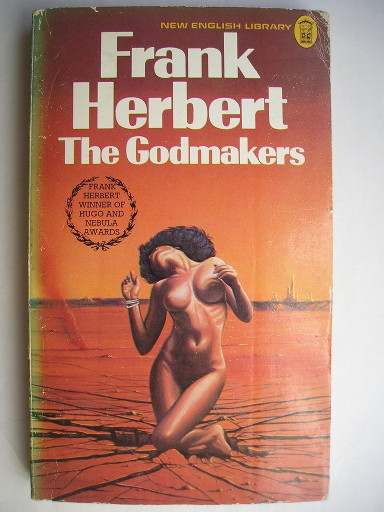
The novel “The Godmakers” – in some editions styled as “The God Makers” – by Frank Herbert was published for the first time in 1972 as an expansion of four short stories published in previous years.
Lewis Orne works for a government agency that aims to identify planets where there’s a risk of war breaking out and to find ways to keep peace. Seeing the signs of that kind of risk is not always easy but his mental abilities seem to develop in such a way that they allow him to perform in-depth analyzes that after various missions lead him to disturbing conclusions.
On the planet Amel, a religious order has the extremely ambitious aim of creating a god and it’s not the first time they have dona that. They don’t know from what creature, or what, it will be born and yet what the Abbod says and does was designed and calibrated with extreme precision because random influences are too dangerous.
The stories that form “The Godmakers” were written in the early part of Frank Herbert’s career and include some of the author’s favorite themes. The resulting novel is set in a future in which humanity expanded into the galaxy, after a catastrophic interstellar war. The recovery is slow and the emerging new civilization seeks to expand peacefully by helping the backward planets where aggressive tendencies are found.
The protagonist Lewis Orne is an agent of this new civilization that has to face problems connected to the relations with the planets to be recovered. Reading the novels you can note that it’s a fix-up of short stories that in origin were separate because it tells different episodes of Lewis Orne’s life that partly unconnected. The common thread that connects most of those episodes is represented by the priests of the planet Amel, who aim to create a god.
The religious theme is mixed in various ways with political and social ones but also with that of psychic powers. They’re developed through Lewis Orne’s deeds that allow Frank Herbert to provide information on some societies that developed after the interstellar war. There are also various scientific elements but those plots show above all various possible political and social developments.
Frank Herbert is particularly interested in some factors that influence a society and religion is recurrent in “The Godmakers” until it becomes central in the final story. Together with the presence of very long-term plans that are developed over generations and the importance of certain mental powers in the creation of a god, those are themes that the author developed much more in the following years in the Dune series.
“The Godmakers” would have deserved a total rewriting of the short stories that compose it to develop not only its themes but also its characters, which are in my opinion the weakest element of the novel. He could very well have turned the short stories into as many novels because he had enough material. However, in those years he started gathering information about the desert dunes, initially for an article for a magazine and the rest is history.
Considering the fact that eventually Frank Herbert wrote the Dune series we can’t complain but in comparison “The Godmakers” seems a draft that still has the merit of having a fast pace. The short stories that form it were written for the magazine market of the time over a two-year period. Fixing them up after several years into a novel seems a commercial operation made to exploit the fame that the author acquired over the years.
The result is not the best novel by Frank Herbert and its flaws can be seen above all in comparison with the Dune series. However, even with a far more limited development, the ideas and themes contained in “The Godmakers” offer food for thought so it could still be interesting to read.
