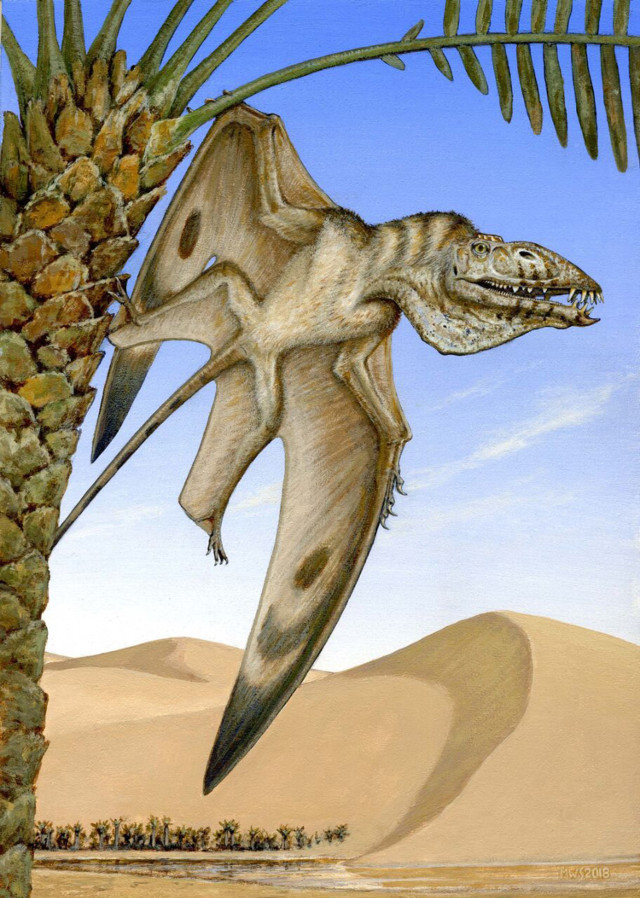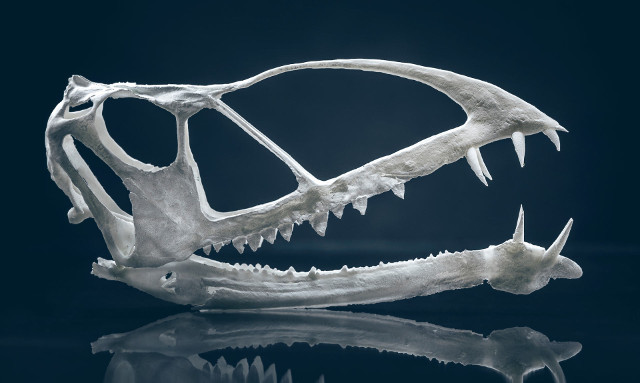
An article published in the journal “Nature Ecology and Evolution” describes the discovery of a pterosaur that lived in today’s Utah about 210 million years ago. Named Caelestiventus hanseni, it was studied by a team of researchers thanks to a CT-scan that allowed to create a 3D model of the only specimen in the sandstone of the formation in which it was found. It’s one of the oldest known pterosaurs and this will allow to better understand the origin and evolution of that group of reptiles.
Pterosaurs emerged towards the end of the Triassic period and the fossils of their early species are rare and so far the only one that wasn’t found in the Alps was the Arcticodactylus cromptonellus, discovered in fluvial deposits in Greenland. The discovery of a new species that lived in today’s Utah is already an exceptional fact but its characteristics make it even more important to offer new information on these reptiles.
The almost complete skull and part of the wing of the specimen of the species that was named Caelestiventus hanseni were discovered in an area that was a desert at the time when these pterosaurs lived there. So far, only species of the pterodactyloid (Pterodactyloidea) suborder and dating back at least 65 million years later were known to live in that type of habitat but the characteristics of the species discovered in Utah indicate that it’s part of another branch that was called Dimorphodontia. It includes what used to be defined as the Dimorphodontidae family before a recent restructuring of the classification of a part of pterosaurs.
The consequence of Caelestiventus hanseni’s desert life is that it got fossilized in sand. That’s positive because this reptile’s hollow bones weren’t crushed because of the compression that is instead exerted by the marine sediments that ended up in the Alps, where many Triassic pterosaurs were found. Often pterosaur fossils are made up of just a few bones or even a single bone and in many cases are fragmented therefore even a skeleton that’s far from complete such as this one is a great discovery.
Extricating Caelestiventus hanseni’s bones out of the sandstone that formed over time without damaging them was a problem so the researchers led by Dr. Brooks Britt of Brigham Young University preferred to subject the sandstone block to a version of the CT-scan adapted to paleontological studies. The result was the creation of a 3D model of the available bones that allowed to conduct an analysis of their characteristics.
The availability of the skull, for example, also makes it possible to reconstruct the characteristics of the animal’s brain, since it preserves an impression of it. In the case of Caelestiventus hanseni, it revealed that this pterosaur had a poor sense of smell but its vision was well developed, an interesting discovery since it’s one of the oldest species belonging to that group.
Another interesting reason for interest came from Caelestiventus hanseni’s teeth, of three different types: long fang-like spikes, large “leaf-shaped” blades, and tiny blades. Two long spike teeth are present near the front of each side of the jaw and there were probably similar teeth at the tip of its premaxilla. On each side of the jaw there are twelve large, triangular, blade-shaped teeth. The maxillary teeth of both sides are made stronger by a central ridge and are bicuspid, which means that they end in two tips.
Caelestiventus hanseni is a large pterosaur compared to the known Triassic species with its wingspan of about 1.5 meters (5′). The researchers found similarities with the species Dimorphodon macronyx, which lived some tens of millions of years later, in the lower Jurassic, between today’s Mexico and England. This indicates that the Dimorphodontidae family already emerged in the Triassic and survived the mass extinction of the end of that period.
This discovery raised a lot of interest for the possibility of studying a Triassic pterosaur of which several bones were found and the significance of the discovery for the history of these flying reptiles. Caelestiventus hanseni shows that 210 million years ago pterosaurs already showed well-developed anatomical characteristics typical of that group and were already diversified. This suggests that our knowledge of pterosaurs suffers from the problem of fossil scarcity, typical in the field of paleontology and even more so for these animals that had bones that were hollow and more fragile than those of other prehistoric animals.