
 An article published in the “Journal of Virology” reports the discovery of a new giant virus that was called Medusavirus. A team of researchers discovered it in northern Japan’s hot springs, where it reproduces by infecting amoebae of the species Acanthamoeba castellanii. The peculiarity of Medusavirus is that it results in the formation of cysts in the infected amoebae, which leads to the growth of a protective covering.
For the past 15 years new species of giant viruses have been discovered and now many of them are known, gradually grouped into different families. A few years ago the creation of a taxonomic group called Nucleocytoplasmic large DNA viruses (NCLDVs) was proposed, although at the moment there’s no certainty that they have a single common ancestor. The only thing they certainly have in common is a huge size for virus standards, so much so that the first ones that got discovered was classified as a bacterium and only years later its true nature became clear.
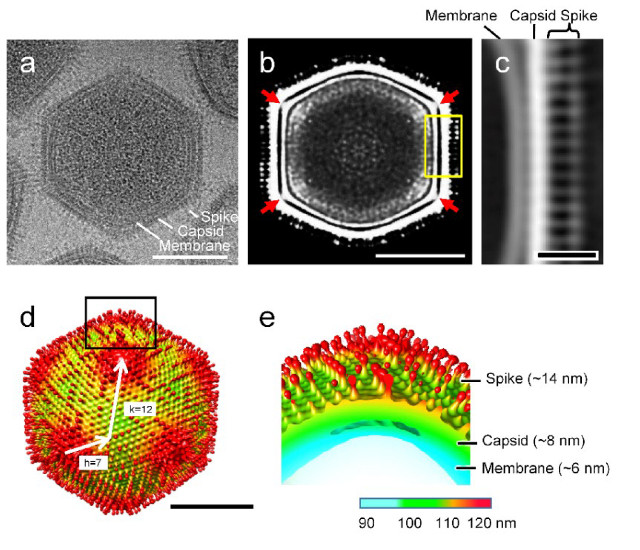
Medusavirus has some characteristics that make it different from the other known giant viruses and for this reason its discoverers proposed the creation of a new family called Medusaviridae. The image (G. Yoshikawa et al./J. Virol. 2019 (CC BY 4.0)) shows Medusavirus under the electron microscope (a), the central part of the 3D reconstruction of Medusavirus (b), the zoom of the part in the yellow rectangle (c), the 3D reconstruction of Medusavirus (d) and the zoom of the reconstruction part in the black rectangle (e).
What’s perhaps the most interesting feature of Medusavirus is perhaps its ability to encode all 5 histones, key proteins in compacting DNA within the nucleus typical of eukaryotic organisms. One possibility is that the ancestors of eukaryotes acquired the genes to encode histones from ancient viruses.
The amoebas that are infected by Medusavirus encode many homologous genes, which means identical to those of this giant virus. For these and other reasons related to the characteristics of these organisms the researchers believe that there was a horizontal gene transfer, with the consequence that the Medusavirus infection left some genes in the amoeba and the giant virus captured some genes from its host.
For these reasons, the study of Medusavirus is particularly interesting to better understand the mechanisms of coevolution, the process that occurs with the evolution of two closely linked organisms such as this giant virus and the species of amoeba it infects. It could also provide evidence of the possible role of viruses in eukaryots’ evolution. For years there have been studies on the genes that multicellular organisms absorbed from viruses and this type of process could have influenced the evolution already in remote times. Viruses are associated with diseases because they’re parasitic organisms but their interactions with the infected organisms can be more complex.
