
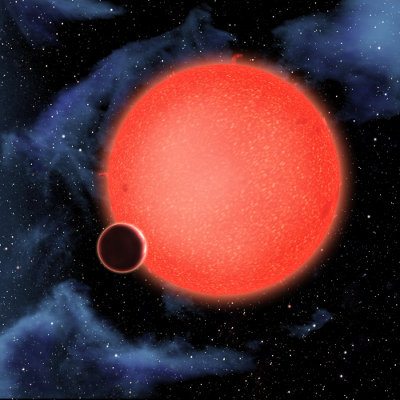
The planet GJ 1214b was discovered in December 2009 using robotic observatory MEarth Project, which monitors the brightness of thousands of red dwarfs to find planets that pass in front of them. In this case, the observed star was GJ 1214, a red dwarf about 40 light years from Earth with a mass about one-sixth the Sun.
The planet GJ 1214b has a diameter about 2.7 times the Earth and a mass about seven times higher. Its average distance from its star is approximately two million km (1.3 million miles) and its orbital period is about 38 hours. Clearly, the surface temperature isn’t exactly pleasant for our standards, being estimated at about 230 degrees Celsius (450 degrees Fahrenheit).
In 2010 a team of scientists led by Jacob Bean of the Harvard’s Smithsonian Center for Astrophysics (CfA) examined the atmosphere of the planet GJ 1214b discovering that it was probably composed mostly of water. A possible alternative explanation was the presence of a kind of haze that covered the planet’s atmosphere.
Now an international team of astronomers led by Zachory Berta of Harvard’s Smithsonian Center for Astrophysics (CfA), confirms that the planet GJ 1214b is covered by water in its vapor state. For this new exam they used the Field Camera 3 (WFC3) of the Hubble Space Telescope to study the planet when it passed in front of its star. At that moment, the star’s light filtered through the planet’s atmosphere, providing clues about its composition.
The haze is more transparent to infrared light than to visible so the observations of the Hubble Space Telescope allow us to see the difference between an atmosphere of steam and of haze. The analysis showed results consistent with the existence of a dense atmosphere of water vapor.
[ad name=”AmazonScience”]
The mass and the size of the planet were measured accurately in the course of the past observations and through them the astronomers were able to calculate its density. The combination of the various measurements indicate that the planet GJ 1214b has a lot more water than the Earth and fewer rocks.
The high levels of temperature and pressure could bring the water to exotic states such as “Hot Ice” and “superfluid water”, unimaginable in the conditions in which we are used.
It’s possible that the planet GJ 1214b formed at a distance from its star higher than the present one, in a zone where water ice is abundant, then it moved to the inside of its solar system. During its journey, GJ 1214b must have passed through the habitable zone of its star and if his movement was slow enough life forms may have developed. Of course, given its current conditions, any survivors would be really exotic. In any case, GJ 1214b is a really special and interesting planet.
