
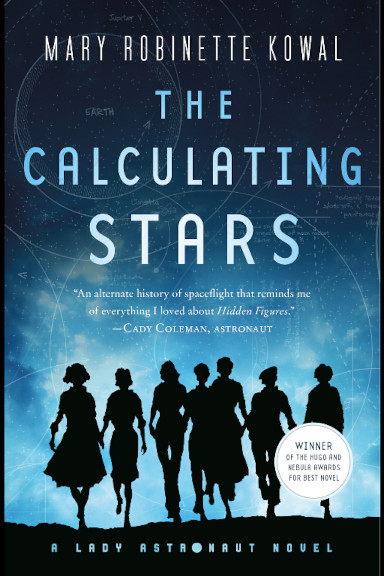
The novel “The Calculating Stars” by Mary Robinette Kowal was published for the first time in 2018. It’s the first novel in the Lady Astronaut series. It won the Hugo, Nebula, and Locus Awards as the Best Science Fiction Novel of the Year and the Sidewise Award for Alternate History Novel of the Year.
In 1952, a meteorite hits the Earth in the Chesapeake Bay. The short-term consequence is the destruction of Washington D.C. and most of the east coast of the USA. In subsequent years, temperatures drop but scientists’ calculations indicate that the heat absorbed by the water will be released over the years causing strong and rapid global warming.
The International Aerospace Coalition is formed to develop a space program capable of colonizing the Moon and reaching Mars. Elma York was a pilot in the Women Airforce Service Pilots during World War II but the newly formed astronaut corps accepts only men and they’re all white.
In 2012, Mary Robinette Kowal published the short story “The Lady Astronaut of Mars”, which introduced Elma York. After writing some other short stories set in the same fictional universe, the author started writing a series of novels that tell the story of the protagonist up to the situation she experiences in the first short story.
The works of the Lady Astronaut series belong to the uchronia subgenre in which some historical events following World War II took place in a different way. The crucial event in that timeline is a meteorite impact that caused a catastrophe with severe long-term global consequences.
The plot was developed by Mary Robinette Kowal through considerable historical research on the 1950s to reproduce the conditions under which a space program could be developed. This includes all the problems of racial and sexual discrimination seen even in the following decade in the real space program. It was a time when men with remarkable mathematical skills became engineers while women with the same skills became computers.
The novel follows the point of view of Elma York, gifted with extraordinary mathematical abilities yet relegated to working as a computer. Her situation is better than that of most women also because she’s the daughter of a general but certain prejudices still limit her possibilities. Her work is crucial because in the 1950s, electronic computers had limited reliability but Elma wants to become an astronaut.
Elma York’s story is developed by embracing both the technical-scientific aspects linked to the space program and the social aspects linked to racial and sexual discrimination. In her fight for a chance to become an astronaut, Elma must also face her own weaknesses. Her family and her mathematical talent brought her privileges but also negative consequences that constitute a further obstacle. In the situation in which she works, any weakness can cost even a man the exclusion from the astronaut group.
Elma York is by far the most developed character, partly because many others come and go. Some of them end up being a bit stereotyped although it must be said that these are stereotypes deriving from certain types of people who were normal in the 1950s and still exist.
“The Calculating Stars” ends on a cliffhanger because it’s the first part of a larger story. If you’re interested in a story where a space program was developed heavily ahead of our timeline while society is the same with its flaws brutally highlighted, I recommend reading it.
