
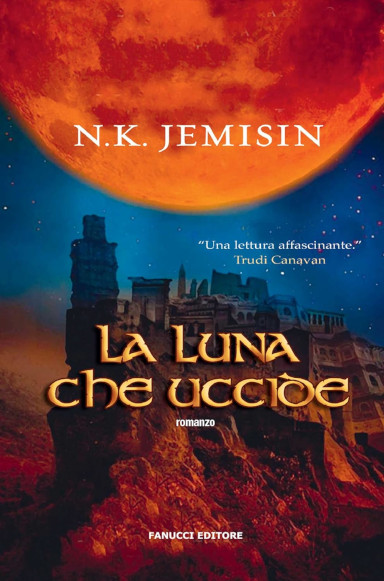
The novel “The Killing Moon” by N. K. Jemisin was published for the first time in 2012. It’s the first book in the Dreamblood series.
Ehiru is considered the best among the Gatherers of the city-state of Gujaareh but when he’s tasked with collecting the soul of a foreigner, something goes wrong. The foreigner claims that there’s a conspiracy that has infiltrated even the temple of Hetawa and Ehiru loses his focus. The consequence is that the foreigner’s soul is destroyed.
Ambassador Sunandi represents the nation of Kisua and is forced to handle on her own a situation that is becoming increasingly complex after her mentor’s death. Her spies reveal to her that Eninket, the prince of Gujaareh, wants to start a war against Kisua and in the city there seems to be a Reaper whose presence is kept secret.
N. K. Jemisin created the fictional universe of the Dreamblood series by drawing inspiration from certain supernatural elements of ancient Egyptian mythology. In Gujaareh, narcomancy, a form of magic connected to the world of dreams, is practiced in the service of the goddess Hananja. The Gatherers send the souls of the deceased to the afterlife and obtain dreamblood, which can be used to heal by the Healers. The people deemed corrupt in some way are killed by a Gatherer, which helps in keeping peace and order in Gujaareh.
The situation in Gujaareh is revealed slowly without infodumps but through the characters’ actions and dialogues. It’s the type of story that requires a certain patience to understand the society of Gujaareh and its religion between the physical world and the world of dreams. Various ramifications developed in that society’s different classes are also at the center of surprises and twists.
The various subplots include many events but sometimes the pace slows down because the narrative focuses more on interactions between characters. There are several characters and the important ones have at least a good level of characterization. They’re also used to offer different points of view on Gujaareh and what’s happening in the city.
Ehiru is one of the protagonists, and his point of view is crucial to the plot because he’s a Gatherer who operates in the world of dreams and therefore is at the center of some key events. He often finds himself exchanging opinions with other people at the temple, starting with his apprentice Nijiri. This is used by N. K. Jemisin to develop the relationships between the characters, which often have different facets, and to offer information on that fictional universe.
None of the protagonists is perfect and there are occasions in which limits and flaws emerge and contribute to their motives. Often, the characters have a difficult past even if by N. K. Jemisin’s standards, the level of tragedy isn’t particularly heavy-handed. For this reason, in general, they also manage to express positive emotions and feelings.
All of this is used to create a fantasy story that is a little out of the ordinary. For someone who’s looking for a setting that goes beyond the classic tropes of this genre, this can be a decisive element. There’s some intrigue but the magical-dreamlike element permeates the whole story giving it a unique flavor.
For readers looking for a lot of action, “The Killing Moon” can be disappointing. For readers who are looking for a progressive immersion in a fantasy fictional universe, I strongly recommend reading N. K. Jemisin’s novel because they will find great satisfaction in it. It’s available on Amazon USA, UK, and Canada.
