An article published in the “Journal of Systematic PalaeontologyJournal of Systematic Palaeontology” reports a study of Helmetia expansa, a species of arthropod that lived about 505 million years ago, in the Middle Cambrian period. Sarah Losso, Jean-Bernard Caron, and Javier Ortega-Hernández examined the fossils discovered over the years in the famous Burgess Shale site for a total of 36 specimens comparing them with species considered close relatives of Helmetia expansa, as they’re included in the Conciliterga group. Over a century after the discovery of the first fossils, this is the first real description of these arthropods that were probably quite close relatives of trilobites.
The species Helmetia expansa was identified in 1918 by Charles Doolittle Walcott, the paleontologist who discovered the Burgess Shale in 1910. This exceptionally well-preserved fossil deposit continues to be explored today, and Walcott himself conducted several excavations in which he found thousands of fossils.
The fossil record for Helmetia expansa is limited, also because the fossils aren’t always in conditions that would allow for in-depth study, especially with the tools available a century ago. This arthropod’s exoskeleton was thin and perhaps semi-transparent, a feature that made its fossilization very difficult. For this reason, this species was rather neglected, at least until now.
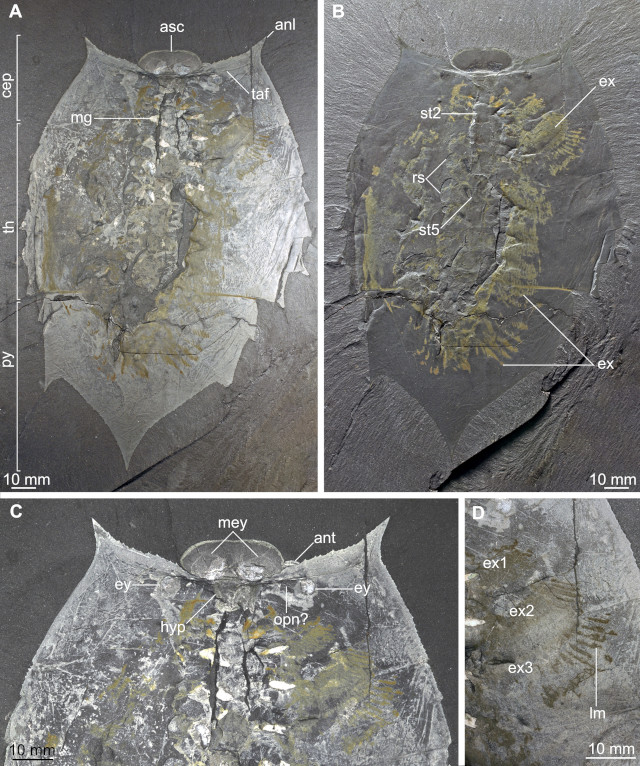
Three researchers conducted a new study of Helmetia expansa by examining the fossils available today. They discovered large gills and walking legs in several specimens of Helmetia expansa. These are characteristics that indicate that these animals walked like their trilobite cousins. Two specimens died during the early stages of the molt, the first time this was documented among the Conciliterga. The length of the specimens varies between 92 and 180 millimeters, offering some insight into their growth and the size they could reach.
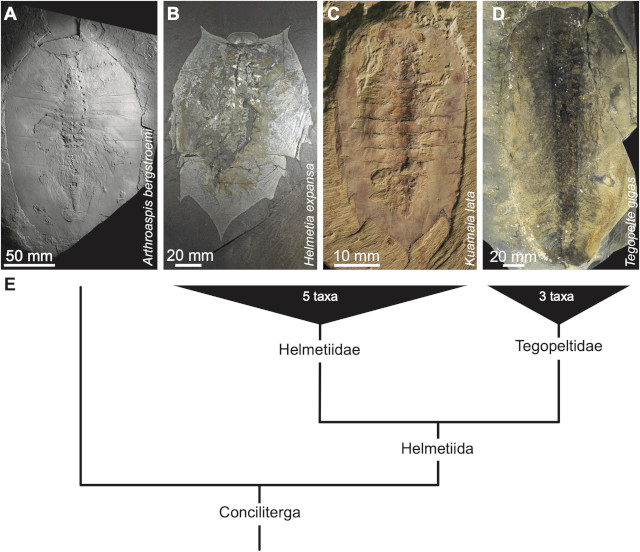
The three researchers also compared the fossils of Helmetia expansa with the other species of the Conciliterga group. For animals that lived half a billion years ago, defining kinships is far from easy and is often a source of controversy. The comparisons were made with fossils of Arthroaspis bergstroemi discovered in Greenland, Kuamaia lata discovered at the Chengjiang site in China, and Tegopelte gigas discovered in the Burgess Shale.
The bottom image (Courtesy Jean-Bernard Caron and Sarah Losso. All rights reserved) shows the fossils of these species and a possible reconstruction of their relations. It represents a confirmation of two previously proposed groups: the helmetids (Helmetiidae) and the tegopeltids (Tegopeltidae). A new conclusion of this study is that Arthroaspis bergstroemi was the species that branched first within the group Conciliterga, to which it was assigned.
It remains to be seen whether the conclusions of this study will be accepted or there will be further discussion. In any case, the researchers showed that the tools available today can exploit the quantity of fossils available to perform examinations that were impossible when Helmetia expansa was identified.