
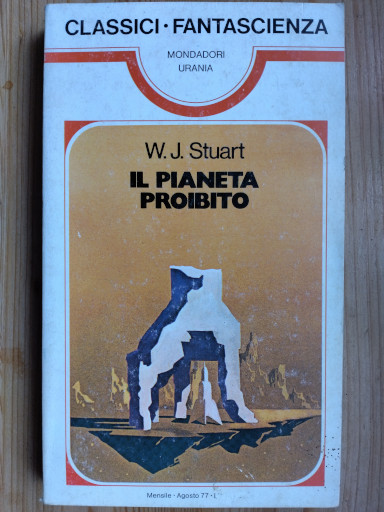
The novel “Forbidden Planet” by W.J. Stuart was published for the first time in 1956.
A spaceship commanded by John J. Adams approaches the planet Altair-4. The mission is to establish the fate of a previous expedition that reached the same planet about twenty years earlier. However, in a radio contact, Professor Morbius tries to convince Adams to turn back because a grave danger awaits the crew on the planet.
Adams is not convinced and lands his spaceship in the area near Professor Morbius’ radio transmitter. While he’s carrying out the first environmental assessments with his crew, Adams is reached by a vehicle driven by a robot that invites them to meet Morbius. A small group goes to meet Morbius and discovers that he has a daughter, Altaira. They’re the only survivors of the first expedition, but the man seems very reticent to explain the details of what happened and the nature of the danger.
Philip MacDonald was above all a famous mystery writer who was hired to novelize the screenplay of the movie “Forbidden Planet” written by Cyril Hume, and the first edition was published a little before the movie was released. It was the only case in which the author used the pen name W.J. Stuart. The screenplay was based on a story written by Irvin Block and Allen Adler, which very freely took some elements of “The Tempest” by William Shakespeare.
The movie was a great success, and over the years, has become a science fiction cinema classic. For this reason, it’s almost impossible to read the novelization without thinking about it. This doesn’t mean it’s impossible to appreciate this novelization, despite its limitations.
In my opinion, the best part of the novel comes from the choice to tell the story in the first person from the point of view of some of the protagonists. This allows to include their thoughts and reflections, which gives them a depth of a kind that isn’t possible in a movie.
W.J. Stuart uses the choice to offer the protagonists’ points of view also to tell some moments that in the movie are very limited. For example, the romantic interlude between John J. Adams and Altaira goes far beyond what is seen in the movie. Some deaths aren’t actually shown in the movie, while they’re described in the novel.
I wonder how this novel would have been developed by a science fiction writer. The movie became a classic because it expresses the best of the science fiction of the time. The story goes far beyond the simple adventure on an alien planet thanks to what emerges about the Krell civilization and the reasons behind the extinction of these aliens.
W.J. Stuart develops the novel around the mystery of the Force mentioned by Professor Morbius as a danger to John J. Adams and his spaceship’s crew. In my opinion, the parts that are most enhanced by the cinematic images don’t have the same impact at a literary level. In particular, the manifestations of the “monster” seemed rather dull to me in the novel. The result is that, in my opinion, the second part of the novel isn’t as evocative as the movie.
In the end, “Forbidden Planet” is a novel that gave me mixed emotions for the combination of its merits and flaws, and because it’s impossible for me not to have in mind a movie that, despite its age, remains a visually extraordinary science fiction cinema masterpiece, available on Amazon USA, UK, and Canada. The novel can still be appreciated for its merits. It’s available on Amazon USA, UK, and Canada.
