
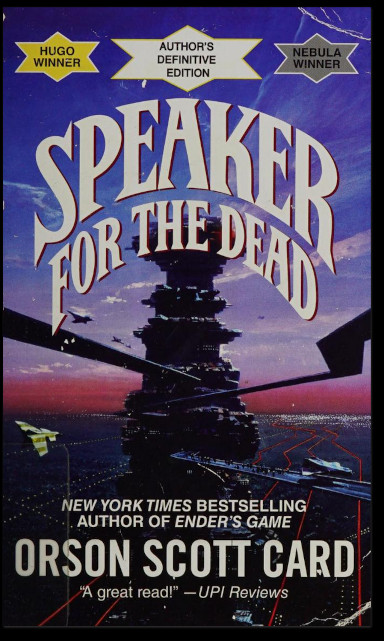
The novel “Speaker for the Dead” by Orson Scott Card was published for the first time in 1986. It’s the second book in the Ender’s Game series and follows “Ender’s Game“. It won the Hugo and Nebula Awards as the best novel of the year.
Pipo is a xenologist who studies the sentient alien species that was discovered on the planet Lusitania. The rules regarding his work are very strict, so he can have limited contact and above all exchanges with those who are familiarly called pigs. When Pipo is killed by the pigs for incomprehensible reasons, his son Libo continues the work but Novinha, who used to be Pipo’s apprentice, has secreted crucial information on the affair.
Andrew “Ender” Wiggin is a Speaker for the Dead and receives via ansible Novinha’s request to write an elegy for Pipo. When he discovers the story of the pigs of Lusitania, he realizes that for him, it’s the opportunity to make amends for his past and find a new home for the queen of the Formics he has been carrying with him for a long time. When he arrives on Lusitania, Ender discovers that Libo has also been killed by the pigs.
“Speaker for the Dead” was conceived by Orson Scott Card as a completely separate work. It was only after some thought that the author realized that the story would work with Ender as its protagonist. Extending the original novella into the first novel in the Ender series allowed him to refine the connections between the two stories.
This novel is set about three millennia after Ender defeated the Formics, and his name is remembered as that of the Xenocide, since he was made the scapegoat for the extermination of the aliens. For this reason, he lives as a Speaker for the Dead who travels from planet to planet making elegies in which he tells the truth about a dead person.
The Starway Congress that runs the human colonies wants to avoid a new war, and even more a new xenocide, so the killing of Pipo and Libo only leads to new restrictions in the contact between humans and pigs. The humans try to interpret the little information that the pigs provide them, and the discussions between the characters on the subject are a central component in this novel. There’s all the goodwill on the part of the xenologists, but their hands are tied by very restrictive rules decided by people who are literally many light-years away.
The theme of contact with alien intelligences is made even more complex by the introduction of Jane, a disembodied intelligence that emerged from the ansible network. She chose Ender as her only contact, keeping her existence secret from the rest of humanity, and throughout the novel, she proves that she’s not human in various ways.
All this makes “Speaker for the Dead” a novel made up, above all, of interactions between people, where the term should be understood in a broad sense since only some of the characters are human. Ender is at the center of many interactions with humans and other species. Sometimes, his interactions with other humans can be the most difficult, for example, because the colony on the planet Lusitania is Catholic and the local bishop sees a Speaker for the Dead as Satan incarnate.
Understanding each other can be difficult even between individuals of the same species, but it can become an almost insurmountable problem when they belong to different species. It’s a theme that was already present in “Ender’s Game” and becomes central in this sequel, with various ramifications that are important in the plot developments.
The war between humans and Formics of which the final part is told in “Ender’s Game” was caused by the difficulty of communicating between two species that were very alien to each other. This sequel continues this theme, among other things, following the difficulties of the xenologists of the planet Lusitania in understanding the natives nicknamed pigs. From this point of view, there’s almost a contrast with “Ender’s Game” for the desire to communicate with an alien species and avoid a violent clash.
Readers looking for action may be disappointed by “Speaker for the Dead” but the ones looking for introspection and reflections will appreciate it very much. It’s precisely for these characteristics that there are readers who consider it superior to “Ender’s Game.” It’s a subjective judgment that concerns two very different novels and I recommend reading them both. It’s available on Amazon USA, UK, and Canada.
