
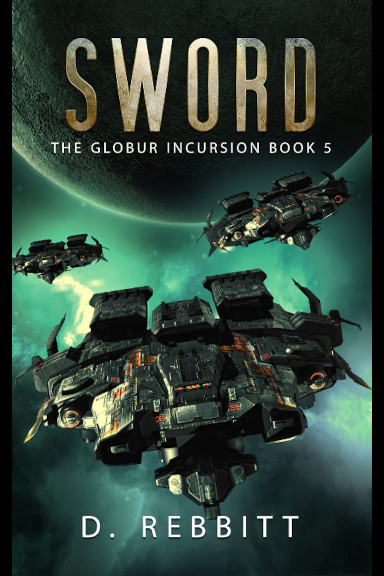
The novel “Sword” by D. Rebbitt was published for the first time in 2020. It’s the fifth book in The Globur Incursion series and follows “Redoubt“.
Rear Admiral Jones has been assigned to patrol a vast area of space spanning two systems populated by many millions of humans. No one knows where the next Globur attack will occur, but Jones has been authorized to take the initiative if he sees a situation in which he has an advantage over the enemy.
Meanwhile, Grand Admiral Medici finds himself in the awkward position of having to answer questions from senators regarding various initiatives taken to strengthen the Imperial fleet. Several senators are hostile and intend to do everything possible to conceal the severity of what they officially call Globur incursions. Some of them just care for their own interests.
“Sword” continues The Globur Incursion military science fiction series, picking up where “Redoubt” left off, following the war that broke out between humans and an alien species known as the Globur after first contact went horribly wrong. This novel is another chapter in the tale of the early years of this war, part of a series of interconnected books that must be read in their entirety to have the complete story.
The intensity of the action has increased book after book, and so has the tension. The fleet commanded by Rear Admiral Jones has all the latest weapons and updated onboard systems, including the Imperial Marines’ armored suits. Despite this, everyone is aware that the Globur are aggressive but also capable of adapting to new situations. D. Rebbitt had already made it clear that his idea was to tell a difficult war for humanity, with moves and countermoves by both sides.
The war between humans and Globur is like a great chess game, but every move brings death and destruction. Humanity found itself unprepared to fight against an alien species that shows remarkable capabilities in the field of warfare, and the effort to repel the alien attacks was enormous, at a considerable cost in terms of lives. Despite this, political attitudes are often negative toward the people who risk their lives to protect humanity.
The political issue has been present since the beginning of the series, and in “Sword” it becomes even more important. The author tells in parallel the subplot in which Rear Admiral Jones engages the Globur and the one in which Grand Admiral Medici faces the Senate. Not all senators are hostile, especially since some of them represent the frontier worlds, who are experiencing the Globur threat firsthand. However, some senators are pursuing only their own personal interests, which are political and, in some cases, economic.
Battles in space alternate with verbal battles in the Senate. In both cases, these are brutal battles, as Grand Admiral Medici’s life is also potentially risking his life in the Senate. This is because the senators most opposed to the expansion of the fleet are seeking a way to justify a charge of high treason, a crime that carries the death penalty.
This chapter in the war between humans and Globur includes some developments familiar to those who have already read the previous books. “Sword” offers a recounting of these developments with many new details, told from the perspectives of Rear Admiral Jones and Grand Admiral Medici. For this reason, even the retelling of familiar events is far from boring.
“Sword” is another novel with an open ending, as it’s the fourth chapter of a larger story that D. Rebbitt partially told in the first book of the series, set decades later, and which he recounts in subsequent chapters. I recommend reading it especially to fans of space opera and military science fiction. It’s available on Amazon USA, UK, and Canada.
