
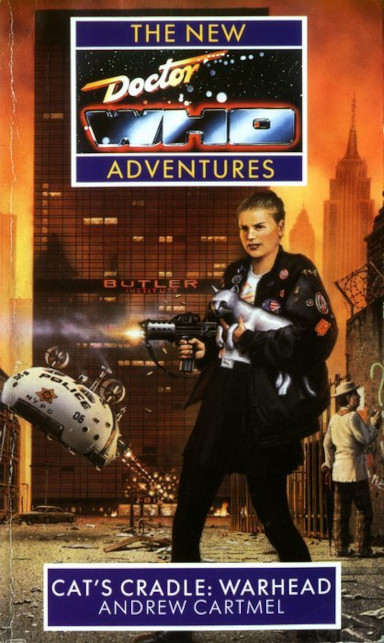
The novel “Cat’s Cradle: Warhead” by Andrew Cartmel was published for the first time in 1992. It’s No. 6 in the “New Adventures” range by Virgin Publishing.
The Seventh Doctor visits Shreela, who is in the hospital at the end of her life. After their meeting, many years earlier, she had become a science writer. The Doctor asks her to publish one last article provided by him, but under her name. The Doctor contacts other people to gather information he needs for his plans.
Ace travels to Turkey to find an object that is important for the Doctor. She hires a group of mercenaries to assist her, expecting to find herself in situations where their presence will be useful. In particular, she wants their cover because the object she seeks is in the possession of an armed group.
“Cat’s Cradle: Warhead” is the second novel in the trilogy, although the plot has no real connection to “Cat’s Cradle: Time’s Crucible“. It’s also the first of three novels written by Andrew Cartmel, who was the script editor of the classic “Doctor Who” series during the Seventh Doctor’s era. The end of that experience, with the series cancellation, didn’t mean the end of his connection to it. This led him, among other things, to write some novels featuring the Seventh Doctor as the protagonist.
During his work on the television series, Andrew Cartmel had developed a master plan for the Seventh Doctor. The development of this plan included the Doctor’s tendency to carry out schemes in which he achieved his goals by manipulating people, including Ace. This novel clearly demonstrates these aspects of the Doctor.
Actually, the Doctor appears little in the story, as he mostly remains behind the scenes, developing his plan. He emerges from the shadows, so to speak, when he encounters other characters who are somehow useful to his plan. For this reason, his presence is felt even when he’s not physically around.
Ace plays a more active role, also doing the Doctor’s dirty work. The two travellers encounter various characters whose roles only become clear as the story unfolds. Among them is Shreela, an old friend of Ace’s who appeared in “Survival“, the final serial of the classic series.
Readers looking for a linear adventure involving space and time travel may be disappointed by “Cat’s Cradle: Warhead.” Andrew Cartmel’s approach to this novel is decidedly more typical of a postmodern and/or cyberpunk story than classic science fiction. The opening section, in particular, is fragmented, to the point that it feels like reading separate stories.
The novel was set in the future that was near when it was written, and in some ways, it’s even closer today. The future described by the author sees a world so polluted that New Yorkers need a lung transplant after a few years to survive. From this perspective, we can’t complain. That pollution is the result of unregulated industrial development carried out by corporations whose executives are only interested in profit. From this perspective, the projection of existing trends into the future isn’t far from reality.
In this future where humanity has quickly descended into a dystopia, the Doctor decides to take radical action against an elite of super-rich people who are only interested in their own survival. It’s an ambitious story in its construction, but also for this reason, the ending feels rushed.
For all these reasons, “Cat’s Cradle: Warhead” is a controversial novel that has divided readers since its publication. The first novels in this series seem rather experimental, with styles that are also quite different from the style of the classic series’ last years. It will especially appeal to “Doctor Who” fans who appreciate the cyberpunk genre and postmodern literature. You might find a copy on Amazon USA, UK, and Canada.
