
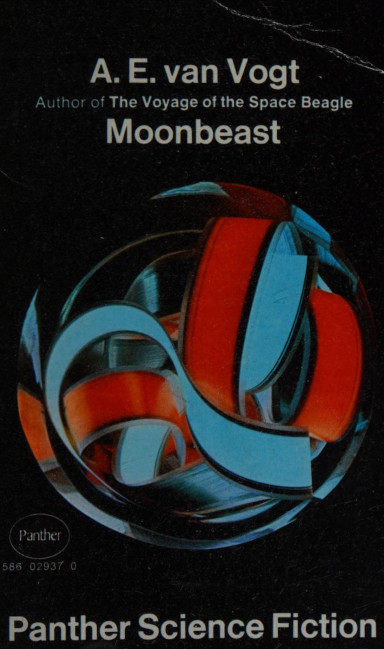
The novel “The Beast”, also known as “Moonbeast”, by A.E. van Vogt was published for the first time in 1963, fixing up stories published in previous years.
Jim Pendrake lives a secluded life after fighting in the war and losing an arm in the crash of his airplane. When he finds a strange engine that seems much more efficient than the ones he knows very well, he can’t help but wonder who could have designed it. His investigations are discreet, but not sufficiently so.
In addition to its extraordinary performance, the engine seems to have strange effects on Jim Pendrake. His physical strength seems to increase, and he notices that his missing arm has started growing back. However, someone seems determined to get their hands on it at all costs. Jim and his wife are separated, but when she gets threatened to force him to hand over the engine, Jim realizes he’s crossed paths with a powerful organization.
When “The Beast” was published, it was common to fix up some stories into a novel. A.E. van Vogt had already done this in the course of his career, but this time, this operation was more radical because the author combined three completely independent stories with different protagonists. This required a thorough revision to make Jim Pendrake the protagonist of the entire new novel and to give the new story a bit of consistency.
Consistency had never been a determining factor in A.E. van Vogt’s works, because they rely heavily on plot twists, no matter how forced or consistent with previous ones. For this reason, the plot of “The Beast” was somewhat disjointed, but in the end, no more so than other works by this author.
A.E. van Vogt gained a lot of experience as a writer in an era when a sense of wonder was a central factor in science fiction stories. “The Beast” fully reflects this very classic approach and incorporates themes very typical of this author.
Even when inspired by some real scientific element, A.E. van Vogt tended to develop them in his own way, regardless of plausibility. In this novel, the increasingly specialized nature of scientific disciplines is mentioned, but the author treats them as if they were completely separate from each other, with no communication between specialists of different disciplines. This is a way of justifying a slowdown in technological progress, which, however, makes no sense considering that research groups are normally multidisciplinary.
The protagonist, Jim Pendrake, is a typical character in A.E. van Vogt’s stories. He discovers he has a superpower, but he’s the first person who doesn’t understand himself. Episodes of amnesia connected to the expression of this superpower are used to justify some radical changes in the story, resulting from the merging of completely independent stories. On the bright side, at least, this partially justifies Jim Pendrake being the first to fail to understand himself.
The result is a novel in which the reader is tossed around along with Jim Pendrake in a relentless series of events told at a fast pace. “The Beast” ends up representing the quintessential A.E. van Vogt, for better or worse. Consequently, it may appeal to readers interested only in classic science fiction based on a sense of wonder, without concern for the story’s consistency. You might find a copy on Amazon USA, UK, and Canada.
