
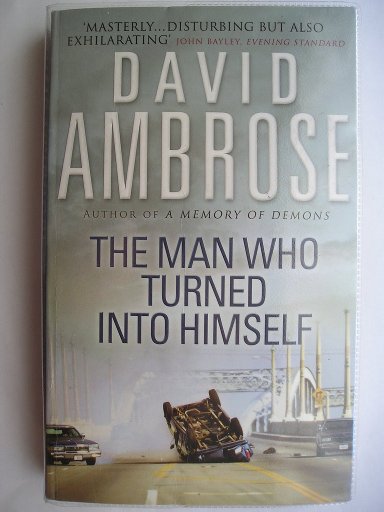
The novel “The Man Who Turned Into Himself” by David Ambrose was published for the first time in 1993.
Rick Hamilton is having one of those days. He falls from his roof risking to break his neck and a few hours later he barely avoid a car crash with a truck. However, the worst is yet to come because during an important business meeting Rick feels the irresistible urge to leave because he’s convinced that something terrible’s going to happen to his wife Anne.
When Rick arrives at the place he felt he had to reach it’s too late and his wife is dead while his son Charlie was unhurt. However, suddenly the scene changes before his own eyes: he’s the one who had had the accident and his wife rushed to the place but when he asks her about their son she’s puzzled and worried because they have no children.
David Ambrose is mainly a screenwriter who for many years has worked successfully for cinema, television and theater. In the ’90s he started writing novels as well and “The Man Who Turned Into Himself” is his debut in this field.
David Ambrose’s experience can be seen in this novel for its visual style and the themes the author had explored in several of his screenplays. “The Man Who Turned Into Himself” is in fact a thriller with science fiction elements in which the protagonist suddenly finds himself in a different reality where he never had his son, isn’t a publisher but a real estate developer and there are some differences in the history of the world.
Initially, “The Man Who Turned Into Himself” looks like a novel about parallel universes, a theory the protagonist knows because among the magazines he publishes there is a scientific one. Rick Hamilton tries to understand how he could’ve passed from his own reality to a parallel one but the others think he had a nervous breakdown as a result of his accident.
The novel is told almost entirely from Rick Hamilton’s point of view but in the course of the novel the reader is forced to wonder how reliable is the protagonist’s perception. In the parallel reality where Rick arrived, he can evaluate the life of his alter-ego Richard, who wonders if his personality got fragmented.
The situation is made more complicated by the discovery of a dark side in the life of Richard which create a comparison not only between Rick’s life and his alter-ego’s but also between their reactions to the events they live.
“The Man Who Turned Into Himself” becomes more subtle and various twists lead to reverse more than once the idea that the reader may have made of the situation. In particular, the second part of the novel with the considerations of Emma Todd, the psychiatrist who tries to help Rick / Richard, gives greater importance to the psychological side of the story.
“The Man Who Turned Into Himself” is a short novel by today’s standards and despite the fact that the protagonist spends a long time expressing his thoughts and speaking with his alter-ego, the pace is high and the story flows smoothly. Inevitably, Rick Hamilton is the most developed character while the others, in their two versions, are seen almost all from his point of view that emphasizes their differences in the two realities. Only Emma Todd has a greater development due to the fact that part of the story is told from her point of view.
“The Man Who Turned Into Himself” is certainly written in a competent manner, the main problem for me is that I’ve read many stories by Philip K. Dick where there are parallel realities and fragmented identities. The consequence is that a novel like David Ambrose’s can’t impress me particularly.
“The Man Who Turned Into Himself” all in all is a nice novel but for its features it seems to be written more for a general audience than for science fiction fans and I feel I can recommend it only to readers who like the themes it deals with.
