
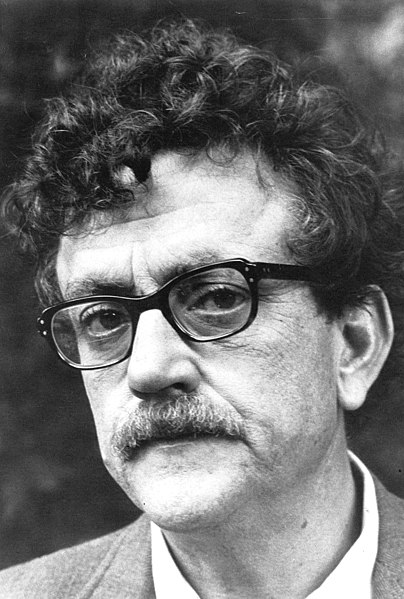
Kurt Vonnegut Jr. was born on November 11, 1922, in Indianapolis, Indiana.
Kurt Vonnegut studied biochemistry at Cornell University from 1941 to 1943 then enlisted in the U.S. Army and during his service he studied mechanical engineering at the Carnegie Institute of Technology and the University of Tennessee.
Sent to the front, on December 19, 1944, Kurt Vonnegut was captured by the Germans during the Battle of the Bulge. Transferred to a prison camp in Dresden, Germany, in 1945 he saw the Allied bombing that destroyed the city. Vonnegut survived because he had been locked in a cave. This experience influenced him a lot and inspired his most famous novel, “Slaughterhouse-Five or The Children’s Crusade”.
At the end of World War II, Kurt Vonnegut resumed his studies, moving to the anthropology faculty at the University of Chicago, and married Jane Marie Cox. When his first thesis was rejected, Vonnegut left the university and moved to Schenectady, where he worked as a technical writer.
In 1951, Kurt Vonnegut decided to start a career as a writer, moving to Barnstable, a town on Cape Cod, Massachusetts. Initially, he published short stories of various genres, from science fiction to romantic ones.
In 1952, Vonnegut published his first novel, “Player Piano”, an anti-utopia set in an America dominated by technology.
In 1959, Vonnegut published “The Sirens of Titan”, a fierce social and anti-militarist satire, which also includes reflections on religion and other issues in which for the first time the inhabitants of the planet Tralfamadore appear.
In 1963, Vonnegut published “Cat’s Cradle”, another satire on the arms race that explores the issues of science, technology, and religion. For this novel, the University of Chicago awarded him a Master’s degree in anthropology.
In 1965, Vonnegut published “God Bless You, Mr. Rosewater or Pearls Before Swine”, in which for the first time the writer Kilgore Trout appeared. This character was inspired by a true Vonnegut colleague, Theodore Sturgeon, but he admitted it explicitly only in 1987, two years after Sturgeon’s death.
In 1969, Vonnegut published “Slaughterhouse-Five or The Children’s Crusade”, a work partly autobiographical which in 1972 was adapted into a movie.
In 1971, Kurt Vonnegut separated from his wife and moved to New York. In 1972 he started teaching creative writing at Harvard University. In 1979 he married the photographer Jill Krementz, a marriage that lasted until 1991.
Kurt Vonnegut kept on writing but the science fiction content of his stories became less and less important, an instrument used to address other issues. Science fiction was never the center of his interest and the writer refused that label more and more.
Kurt Vonnegut died on April 11, 2007, after a fall down the stairs of his house that caused him severe trauma to the head which proved fatal.
Kurt Vonnegut has often been compared to Mark Twain, of whom he was a great admirer, for the fierce irony he used to talk about important issues of life. He’s considered one of the greatest American writers regardless of the genre.

Permalink
Vonnegut’s zany and surreal world reflects the absurdity of our own and really bended my mind to different modes of thinking. His work has inspired my own visual arts for quite some time and I created a tribute illustration of the author with the help of an old typewriter. You can see it at http://dregstudiosart.blogspot.com/2011/11/happy-birthday-mr-vonnegut.html and tell me how his work and words also affected you.
Permalink