
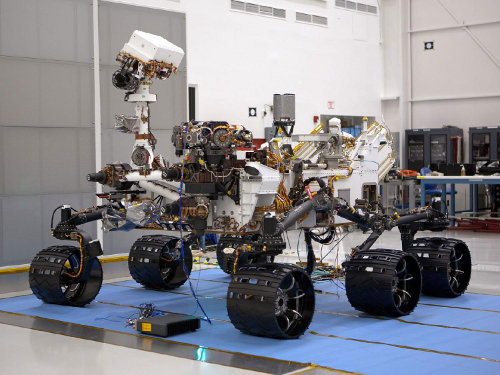
At the European Geosciences Union General Assembly 2013, held in Vienna, Austria, some members of Mars Rover Curiosity mission team have shown some discoveries concerning Mars atmosphere. In particular, they found new evidence that in the past the red planet had a much thicker atmosphere that has been lost over time until it reduced to about 1% of the Earth’s one at sea level.
for this Martian atmospheric research the Mars Rover Curiosity used its Sample Analysis at Mars (SAM) instrument to analyze an air sample using a process that concentrates some selected gases. The result was the most precise measurement ever obtained of the argon isotopes present in the Martian atmosphere.
The SAM has allowed to establish that the Martian atmosphere contains a quantity of argon-36 four times greater than the heavier isotope argon-38. The original ratio between these two isotopes in the solar system estimated thanks to surveys of the Sun and Jupiter is larger, about 5.5 to 1. The inference is that on Mars the argon-36 isotope has dispersed into space more than argon-38 because it’s lighter.
The Mars Rover Curiosity has also performed other atmospheric analyzes using another instrument, the Spaniard Rover Environmental Monitoring Station (REMS), a small weather station that has allowed the rover to carry out the first systematic measurements of humidity on Mars.
The dust, always present in the Martian atmosphere, has been examined by the Mars Rover Curiosity using its Chemistry and Camera (ChemCam) instrument. A laser hit the dust and the spectrum of light emitted has allowed to establish that it contains not only iron oxides but also other complex molecules that include hydrogen.
During April, the Mars Rover Curiosity will continue a series of activities programmed during March. For a few weeks, the Sun will be between Earth and Mars, therefore, the communications won’t be reliable so it would be risky to send commands to Curiosity.
The study of Mars atmosphere is far from over, so much so that NASA has already planned for this year the Mars Atmosphere and Volatile Evolution (MAVEN) mission, a space probe that will be sent to the orbit of Mars with the specific aim to study its atmosphere in order to understand its evolution and current status.
The recent research carried out by the Mars Rover Curiosity will be useful to the MAVEN spacecraft in its work to understand how a planet that long ago was perhaps similar to the Earth turned into what it’s become today.
[ad name=”Google Adsense 300″]

Permalink
cool update here including pics of the rover making its way to mount sharp
http://newsmoves.com/curiosity-continues-to-search-for-the-red-planets-secrets/