
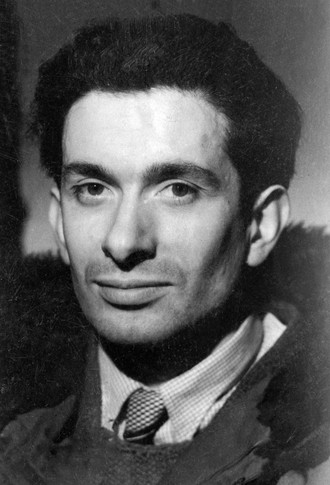
René Barjavel was born on January 24, 1911, in Nyons, France. His father was a baker, his grandparents were peasants, and his origins influenced his work.
Barjavel began his journalistic career at eighteen. His work as a writer began in the ’30s, but his most famous stories started being published during World War II, when the devastation in Europe led him to write about the most recurrent topic in his stories, the collapse of civilization.
In 1943, “Ravage” (translated as “Ashes, ashes”) was published, and Barjavel, traumatized by the war, expresses all his pessimism in a story that begins in the middle of the XXI century when electric machines stop working, causing the total collapse of civilization. The salvation of humanity is seen in a return to farming with the use of pure manual work only, and the creation of any machine is prohibited, so the novel ends with the murder of a hapless inventor of primitive machinery that was intended to make the work of farmers less hard.
The real obscurantism shown in “Ravage” caused some criticisms towards Barjavel, and the fact that the novel was published when France was ruled by the regime controlled by the Nazis even led to suspicions of collaboration.
In 1943, “Le Voyageur imprudent” (translated as “Future Times Three”) was also published. In this novel, a time traveler wants to kill Napoleon but ends up killing one of his ancestors: it is perhaps the first story in Europe with this temporal paradox.
Despite the controversy, René Barjavel had become a pioneer of French science fiction, but initially he was little known even in his own country because in those years, science fiction was essentially an Anglo-Saxon phenomenon. For that reason, Barjavel kept on being a writer but working also as a scriptwriter for films. He also kept on working as a journalist and a critic.
In 1968, “La Nuit des temps” (translated as “The Ice People”) was published. In this novel, an Antarctic expedition finds the relics of an ancient civilization, and a couple in suspended animation is awakened. The collapsed civilization described in this story is older than ours, but there is a risk that the apocalypse might happen again. This book marked his breakthrough as a writer in France.
In his later novels, Barjavel continued to explore the topic of the collapse of civilization, but without the pessimism with no hope of progress like in “Ravage”. You could see more open ideas, such as a favorable view of sexual liberation.
René Barjavel died on November 24, 198,5 and not accidentally, he was buried near his ancestors.
Barjavel is still a relatively unknown writer outside France: just a few of his novels have been translated into other languages, making it impossible to give a complete opinion on his work. Inevitabl,y a pessimistic novel such as “Ravage” may discourage readers from seeking more of his stories that could provide a deeper insight into René Barjavel’s ideas and how they evolved out of the dark time of the war.

