
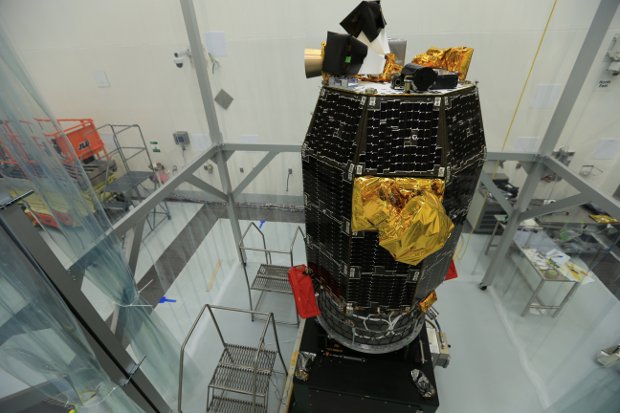
NASA has confirmed that the Lunar Atmosphere and Dust Environment Explorer (LADEE) space probe concluded its mission, which began in September 2013, crashing on the dark side of the Moon. This is the normal end of this type of missions as the purpose is to avoid that a probe might become a space wreck with the risk of it being drawn back to the Earth’s orbit causing potential dangers.
The LADEE space probe reached lunar orbit in November 2013 and after 100 days concluded its primary mission, which aimed to study the Moon’s tenuous atmosphere. Thanks to the precision of the maneuvers carried out since its launch, it stille had an amount of propellant higher than expected, so the mission was extended by one month.
In the final phase of its mission, the LADEE probe was driven closer to the surface, to make its final measurements at an altitude of less than 2 km (about 1 mile). This made it possible to collect data that are unprecedented but even those have allowed, at least for now, to clarify the mystery of the Moon’s sunrise glow above the horizon noticed by astronauts during the Apollo missions.
On April 11, 2014, the LADEE spacecraft started the latest series of maneuvers that brought it in a trajectory towards the dark side of the Moon, far away from the sites of the Apollo Moon landings. The last descent led it to crash into the lunar surface at an hour estimated to be between 4.30 and 6:22 GMT on Friday April 18, 2014. The imprecision is due to the fact that at that time it wasn’t visible.
The LADEE spacecraft’s primary mission was scientific in nature but the budget of $280 million was spent for its experimental nature as well. It’s in fact a probe built using a new design system that follows certain standards that will also save a lot of money in the construction of future probes. Part of the budget was allocated to the Lunar Laser Communications Laser Com Demo (LLCD), a laser communication system that was tested with a great success.
The last test performed by the LADEE spacecraft was on the occasion of the lunar eclipse between april 14 and 15. LADEE survived the very low temperatures and the intensive use of the batteries due to lack of sunlight. It’s a confirmation of the high quality of its design, which is very useful to know exactly because in the future other space probes will be built to the same standards.
The Lunar Reconnaissance Orbiter (LRO) space probe will try to locate the crater caused by the crash of LADEE. Above all, there’s a huge amount of data to be analyzed for a mission already considered a great success.
[ad name=”eBayUSUKAstronomy”]
