
This week, in Washington, DC, the Humans 2 Mars Summit was held, organized by Explore Mars, Inc., a non-profit organization that aims to promote sending humans to Mars within the next two decades. Inevitably, among the many speeches those of NASA’s heads such as Administrator Charles F. Bolden, Jr. were the highlight. He stated that if humanity is to survive until the distant future it must learn to survive on other worlds.
Today Charles Bolden is responsible for administration but when he talks about space missions it’s not just because he has seen them in the monitor at NASA. Bolden was an astronaut who flew on four Space Shuttle missions: the STS- 61-C on the Columbia, the STS- 31 on the Discovery, which carried the Hubble Space Telescope into orbit, the STS-45 on the Atlantis and the STS-60 again on the Discovery. In the last two missions he was the commander of the Space Shuttle.
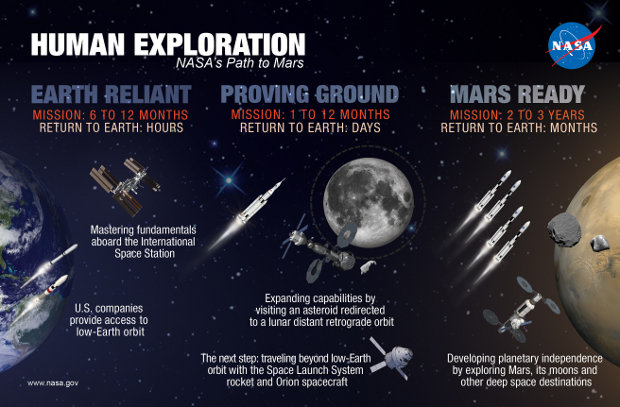
Charles Bolden was appointed NASA administrator by President Barack Obama in 2009. In 2010, Obama challenged the nation to send humans to asteroids by 2025 and to Marse in the ’30s of this century. NASA is trying to develop a program that can accomplish this long-term project through a series of steps.
According to Charles Bolden, humanity must become a multi-planet species to ensure a long-term survival. Our global society has become very sophisticated but also vulnerable, more so because the growing human population places increasing pressure on the Earth’s ecosystem. A planetary catastrophe such as an asteroid impact of a certain size or the explosion of a supervolcano would cause at least the death of billions of people or even the extinction of the human species.
Another speech at the Humans 2 Mars Summit was given by NASA’s Associate Administrator for Human Exploration and Operations William H. Gerstenmaier. The specific theme he addressed is the approach to a manned mission to Mars. In the past, NASA tended to launch its missions in relatively short periods, including space probes to Mars. Now the agency needs a pioneering approach with a series of missions that develop the technologies required to eventually bring human beings to Mars.
The mission to the asteroids is currently still only a theoretical project but according to Charles Bolden is a key step in developing the technologies required to travel in deep space. The problem is always in the costs, definitely huge but tiny when compared for example to military expenses.
In recent decades, the technologies developed for space programs have brought huge benefits to everybody, just think of the developments in telecommunications, solar panels or recycling systems. In the future, they’ll also serve to ensure the survival of the human species.
[ad name=”AmazonScience”]

Permalink