
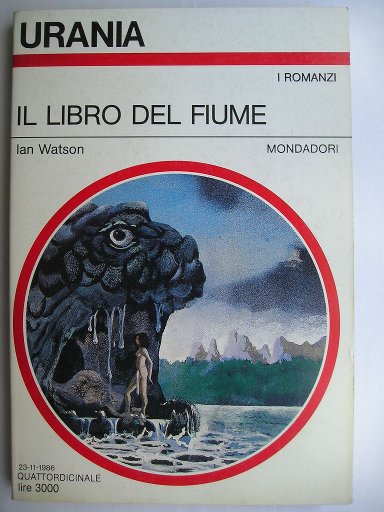
The novel “The Book of the River” by Ian Watson was published for the first time in 1983. It’s the first book of the Black Current trilogy.
Yaleen fulfilled her dream to join the River Guild. Only women can become sailors because the River allows men to travel only once on its waters and those who try to violate that rule go mad or die. After her initiation, Yaleen is bound to the River and must keep the secrets of her Guild.
The Black Current that is a part of the River prevents from crossing its waters isolating the two coasts. A group of men manages to find a way to get to the west coast and Capsi, the Yaleen’s brother, makes the journey. The experiment succeeds but on the other side of the River live a society of fanatics who burn women to the stake and Capsi ends very bad too. Yaleen ends up involved in events that will change not only her life but also that of the entire planet.
Rivers are the protagonists of many stories, including science fiction ones. In this case, it’s a very special river because inside it there’s the Black Current, a mysterious living creature that has a strong influence on the inhabitants of the two coasts. Generally it accepts that women travel on the River, however men can make only one trip. It also makes it impossible to cross the River keeping the two coasts separate.
On the east coast, there’s a society in which women, being the only ones that can travel regularly along the River, formed the River Guild, which runs trade and communications through their boats. For this reason, they’re the strong sex in a role reversal. Satire isn’t the primary purpose of “The Book of the River” but sometimes Ian Watson seems to enjoy reversing certain stereotypes.
However, the societies of the two coasts are overall the consistent result of the actions of the Black Current. The author examines two societies that could arise as a result of that influence. In the course of the novel, following Yaleen’s trips the readers can discover how they work and their problems.
Yaleen is a girl who fulfills her dream to become a sailor but her trips will take her farther than she might have thought. Due to a number of circumstances, she finds herself at the center of events that end up disrupting a society that remained stable for a very long time. What changes everything is the end of separation between the two coasts.
The inhabitants of the eastern coast know the ones on the western coast only thanks to what they can see through their telescopes. What they see is anything but nice as it seems that the society on that coast is made up of fanatical misogynists. The discovery of a way to cross the river opens the way to the contacts between the two societies, which is definitely violent.
Yaleen is at the center of these revolutionary events and has the chance to discover many things about the Black Current, her world and the origins of its inhabitants. “The Book of the River” contains elements typical of Ian Watson as the perception of reality by the protagonist expands over the course of the novel thanks to her discoveries.
The inhabitants of the east coast don’t know their origins. When Yaleen has the chance to speak with the inhabitants of the west coast she discovers their ideas and thanks to her mental connection with the Black Current she can add more details to those ideas. However, they’re not necessarily complete nor entirely reliable.
Ian Watson likes to mix scientific elements with others more mystical. In “The Book of the River” a form of transmigration of souls is an important element, but the author uses the term ka, a reference to the concept that the ancient Egyptians had of the vital essence of the people. The Black Current is a physical being but its effects are generally mental and is another typical element of Watson, who often put in his novels strange creatures that affect the protagonists.
“The Book of the River” is narrated in first person by Yaleen, who writes about her adventures. For this reason, she’s the most developed character while all the others, who come and go, are described from her point of view. The novel is short by today’s standards and contains a lot of action and twists that keep the pace fast. The story has its end but leaves a number of narrative threads open for the next novel in the Black Current trilogy.
Ian Watson isn’t an easy author to read because in his stories he mixes many ideas, even heterogeneous. The result isn’t always successful but I think “The Book of the River” turned out really well. If you like novels full of ideas mixed with great imagination, I recommend reading the Black Current trilogy .
