
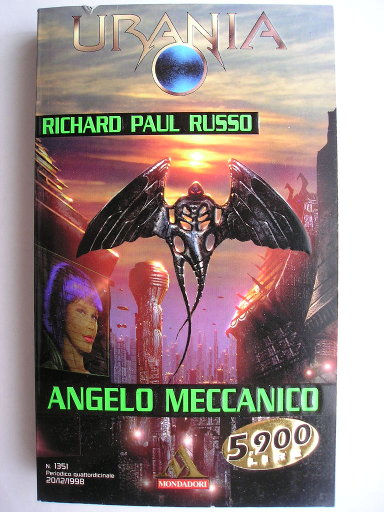
The novel “Destroying Angel” by Richard Paul Russo was published for the first time in 1992. It’s the first in the Frank Carlucci series.
Louis Tanner left have the police for some time and one of the cases in which he was involved that remained unsolved concerns a serial killer who threw the bodies of his victims in the San Francisco bay with angel wings tattooed on their skin. The murders stopped for unknown reasons for a few years but suddenly restart.
Tanner can’t pretend nothing’s happening and reconnects with Frank Carlucci, a former colleague still in the police. At the time of the first investigation, Tanner was contacted by a criminal who claimed to have information useful to find the serial killer and he was listed as the person to meet to communicate such information. After the the murders restarted, that old trace may be the only one useful to solve the case.
“Destroying Angel” introduces the series of the cop Frank Carlucci but in this first novel he’s a supporting character. The real protagonist is Louis Tanner, an ex-cop who has seen too much in the decadent San Francisco of the mid-21st century. In this cyberpunk-inspired future, between cyborgs and new synthetic drugs, there’s a serial killer who’s performing his ritual murders.
The novel is a science fiction detective story with noir / hard-boiled elements. Being set in a not too distant future, sometimes it seems one of the many Chandler-inspired novels but then some cyborg or some future technology pops up to remind us its cyberpunk side.
When he was a cop, Tanner was chosen as a contact by a criminal who claimed to have information about the serial killer and after the murders restarted that seems to be the only trace available to the police. In the end, the story follows especially the search for this criminale rather than the direct one for the serial killer.
During his search, Tanner ventures into the Tenderloin, a really dangerous San Francisco district. There, his path crosses that of Sookie, a homeless young girl who survives as she can but sometimes is too curious for her own good given as she can happen to see something she shouldn’t.
Between Tanner and Sookie a strange collaborationstars and, even though the parts of the story about the little girl may seem digressions that aims only to emphasize San Francisco’s decadence, eventually they’re important to the plot. Maybe Richard Paul Russo exaggerates in wanting to create a connection between the two of them in the fact that Sookie looks like a Tanner’s old flame though she can’t be her daughter.
I confess that reading “Destroying Angel” left me a bit cold. The novel contains hard-boiled and cyberpunk elements that seemed to me pretty standard not to say cliches. In Tanner’s investigation, mostly indirect because only in the last part there’s a real hunt for the serial killer, there’s tension because he constantly risks his life getting into criminals’ circles but the story didn’t look particularly brilliant to me.
I have to say that “Destroying Angel” isn’t my favorite type of novel. Generally I donìt read noir / hard boiled stories and cyberpunk is definitely not among the science fiction sub-genres that excite me. When for some reason I read a science fiction story that contains elements of those genres I can appreciate it if they are used in a brilliant and original way, otherwise I don’t get passionate about it.
Despite my personal misgivings, I can’t say that “Destroying Angel” is poorly done. The plot has its sense, the setting is well-built and at least the protagonists Tanner and Sookie are well developed. The fact is that all this isn’t enough for my taste.
“Destroying Angel” seemed to me all in all pretty good but I realize that in my opinion there’s an element of personal taste stronger than usual. Probably it’s a novel that will appeal to cyberpunk fans and perhaps also to hard-boiled detective stories fans.
