
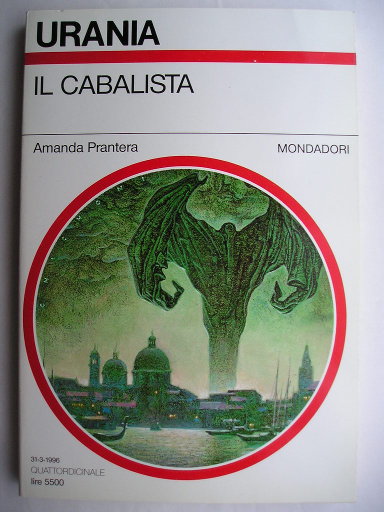
The novel “The Cabalist” by Amanda Prantera was published for the first time in 1985.
Joseph Kestler is a magician and Cabalist who conducts his research in the field of the occult in Venice very seriously even if the diagnosis of a terminal illness threatens to interrupt it. For years, his goal has been to show the validity of the magic system he was trying to apply in front of a group of scientists to prove that magic really exists but the prospect of death changes things.
Joseph Kestler has decided to leave some kind of testament in which he reveals his discoveries. His research has been difficult not only because of the very complex subject with many hidden secrets but also because he realized that there are forces that hinder him. Is it possible that a kid who lives next to him is actually the Catcher?
What has been called a metaphysical thriller tells the story of Joseph Kestler, a mathematician and a Cabalist. He lives in Venice, where a diagnosis that leaves him no hope leads him to prepare his legacy. However, he fears that the Catcher can seize it for dark purposes.
Joseph Kestler’s story is esoteric with supernatural implications and, as typically happens to the characters who carry out this kind of research, it contains a lot of introspection. The protagonist lives almost isolated, with rare regular contacts only with some acquaintances and generally other people think he’s working as a translator.
The setting in Venice allows Amanda Prantera to create a story with a unique atmosphere in which Joseph Kestler tries to complete his research before his death but at the same time is forced to defend himself from the Catcher. He thinks he has identified him in a strange boy who personifies an evil force that wants to take possession of Joseph’s secrets.
My main problem with “The Cabalist” is due to the fact that it’s a novel that’s short by today’s standard yet it often gives the impression of being somewhat diluted by Joseph Kestler’s many, many thoughts. His research is lonely so his most secret thoughts are not shared with other people but remain confined within his mind.
I found various moments of that type rather boring because they seemed too often vague. A story based on an esoteric research tends by its nature to have little action and to work must be tightly focused on the elements it’s based on in order to keep the reader’s attention alive.
Instead, Joseph Kestler’s thoughts often appear fragmented. From one point of view, this makes the protagonist more realistic, a person who’s normal except for the type of research he’s conducting whose thoughts can’t always be focused on a single topic. On the other hand, in a story that normally has already a slow pace, in my opinion slowing it down even more does’t help the novel’s readability.
Not only Joseph Kestler has a lot of thoughts on his mind but there are also those by an out of the ordinary narrator as he doesn’t just tell the story but sometimes also add his observations. This characteristic becomes part of the problem because it adds further digressions that don’t add much to the story.
The plot works when Joseph Kestler focuses on his research and where he interacts with other characters, but these are secondary except for the Catcher. If Amanda Prantera had written a novella the story would have been more intense highlighting more its plot and atmosphere.
In the end, the impression I got from “The Cabalist” is of a partly wasted opportunity. The result is fair but I think Amanda Prantera could have done better. It’s a novel fans of esoteric and particularly introspective stories might still like.
