
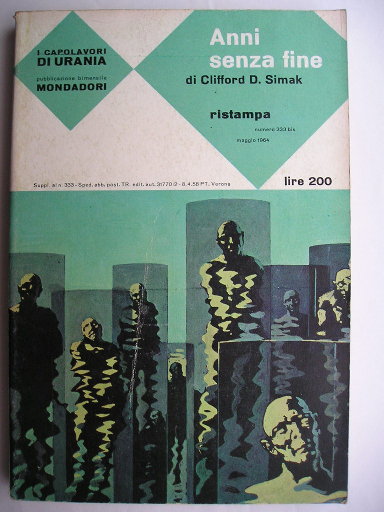
The novel “City” by Clifford D. Simak was published for the first time in 1952. It won the International Fantasy Award.
At the beginning of the 21st century technology has made leaps forward in building extraordinarily efficient and fast vehicles. The consequence is that human beings have started abandoning cities because they can go and live in the countryside and move very quickly to go to work anywhere.
The progressive death of cities is just one of many great changes that occur in future human society. Space exploration leads to contacts with aliens, which in various ways affect humans. Over the centuries, on Earth the Webster family, the protagonist of many changes, also contributes to the evolution of dogs.
“City” is a novel composed of a number of short stories published between 1944 and 1951 in the magazine “Astounding Science-Fiction” that were later fixed-up into a novel. The stories, that tell stories separated even by millennia, are accompanied by introductions that connect them and set the tone. One last story was written in 1972 and is therefore only present in the editions printed after that year.
The result is that Clifford D. Simak created a large unified story getting over what generally are limitations arising from the fix-up of stories set in very different times. Above all, the stories that make up the novel become legends that reached the dogs’ civilization.
The introductions to the stories are written in a distant future where the dogs have their own civilization and proof of the human beings’ existence have disappeared. The consequence is that there are only ancient stories about tuem but among the dogs there are heated debates about their reliability.
The events that led to the birth of the dogs’ civilization and the loss of the memory of the human beings’ existence are explained in the various stories. The human civilization goes through profound changes, starting from the abandonment of the cities. They’re made useless by the enormous progress of vehicles, which allow to move quickly even through long distances.
Clifford D. Simak was strongly connected to a pastoral world and “City” begins with the return of people to the countryside. Therefore it seems paradoxical that the change represents the first act of the human civilization’s decline. On the other hand, under several points of view humans are described in a negative manner, so much that according to some dog scholars they have never existed but were invented as a sort of bogeyman (bogeydog?) for children.
At the center of the great changes in human civilization there’s the Webster family, which represents the humans’ positive sides but also the negative ones. The family members are often bright and their works influence human history but not always in a positive way. Some of them bring progress but others end up inadvertently cause damage to humanity.
The story of the Websters and the robot Jenkins, at the service of many generations of Websters, allows us to understand the changes that occur over the course of millennia of human civilization and the rise of the dogs civilization. Some readers might not like the fact that human history must be somehow inferred from that of the Webster family but in my opinion it’s an effective way of telling the story.
The introductions to the stories give a certain fairy-tale tone, thanks to their often pastoral setting. This allows Clifford D. Simak to give his best in a big story that often becomes philosophical with many reflections on the part of humans, dogs and occasionally other creatures.
If you’re looking for action stories, “City” is definitely not for you. The various stories explore the possible consequences of certain choices and in the end the characters are also used to represent certain ideas. The consequence is that their development is limited, also because few of them are present in more than one story.
“City” is a science fiction story that strictly speaking is only partially correct to define humanistic because there are also the dogs. Besides the definitions, it’s rightly considered a classic and a must-have for whoever is interested in science fiction but in my opinion should be read regardless of genre labels.
