
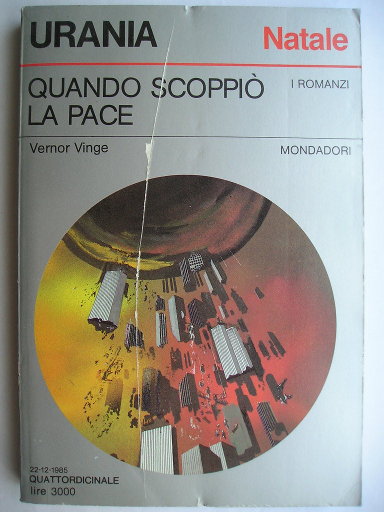
The novel “The Peace War” by Vernor Vinge was published for the first time in 1984.
Paul Naismith may seem one of the aristocrats that exist in the almost feudal society emerged in the decades after the war and plagues but soon Wili Wachendon realizes that he’s much more. The man is involved in the activities of the Tinkers, who are developing technologies clandestinely, trying not to be discovered by the Peace Authority.
Wili becomes Naismith’s apprentice and starts learning more and more advanced math concepts. Gradually, he starts contributing to the Tinkers’ research and there comes a time when he gests involved in plans which also cover the bobbles, spherical force fields that completely isolate whatever is within them.
“The Peace War” begins the series called Realtime or Bobble, a reference to the bobbles, the force fields whose invention eventually start a war that ravages the world. The bobbles are used as weapons to imprison enemy installations and create barriers impossible to cross.
After the war, the Peace Authority emerged to impose a sort of world government to the survivors. The price is an important limitation to any other authorities and the prohibition to conduct scientific and technological research. However, Tinker groups continue with their developments in clandestine laboratories.
In this scenario that can be called post-apocalyptic, young Wili Wachendon meets the mysterious Paul Naismith and, thanks to his potential, becomes his apprentice. The initial part of “The Peace War” is about Wili’s education and this allows Vernor Vinge to provide information on that future, on the Peace Authority, the war and the plagues that led to that situation and the bobbles.
This initial part is slow and at times heavy, structured in a way that gives a been-there-done-that impression considering that there’s a boy with an difficult past who finds a mentor who helps him to develop an extraordinary potential. You needs a little patience to get to the point where the pace accelerates a lot entering the stage where there’s also a lot of action.
However, it’s clear from the start that “The Peace War” is a novel based very much on the ideas that concern authorities and scientific and technological progress and the relationships between them with a particular relevance to the ethical problems connected to them. The world described in the novel is the result of the abuse of technology caused by a thirst for power that corrupted the people who ended up causing a global catastrophe.
The story is somewhat a clash of philosophies with the Peace Authority, who believes that the only way to avoid more wars is to have the monopoly of technology, and the Tinkers, conducting clandestine research. It’s often a clash of intelligence because the two sides are trying to spy on each other and it’s a mental battle in the sense that the two factions are trying to outsmart each other.
The Peace Authority has no problem using violence but tries to limit it to cases in which it’s considered necessary. From this point of view Vernor Vinge is subtle in building a story in which there isn’t a simple fight between the good Tinkers and the bad Peace Authority but explores the motivations of both sides.
In the end, a Peace Authority’s agent must admit that there’s a tyranny, at the same time justifying it as the price for peace and arguing that it’s milder than any in history. Power ends up corrupting and to keep it an increasing use of force can be justified.
The ethical theme become even too vast for a novel that’s not particularly long. For example, in the future California in which it’s set racism and sexism are normal and the social problems would deserve more space to get developed but there’s not enough. Character development is even more sacrified to the development of the ideas so only very few characters have any depth.
The result is a novel that is far perfect but I found “The Peace War” extraordinary from the point of view of the development of its basic ideas and in particular the ethical issues. For this reason I recommend reading it.

Permalink