
Biology

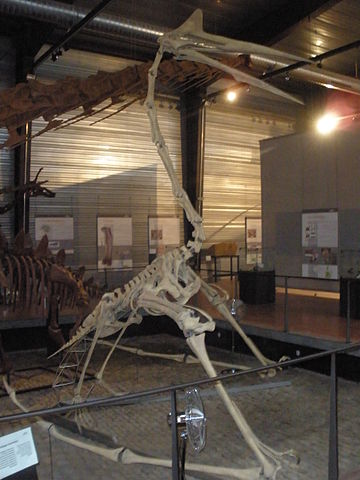
Quetzalcoatlus fossil

On April 5, 2014, the American Museum of Natural History in New York opened an exhibition devoted to pterosaurs that will last until January 4, 2015. This has brought to the spotlight those ancient reptiles and the knowledge accumulated over time on them thanks to research carried out by many paleontologists from around the world.

Illustration of some application of BTO research (Image courtesy DARPA. All rights reserved)

DARPA (Defense Advanced Research Projects Agency) has opened a new division called Biological Technologies Office (BTO), which aims to develop biotechnologies. It’s a field in great development in recent years and the American agency intends to explore in particular the intersection of biology with physical sciences leading to a merge with engineering and computer science.

Fossil of Askeptosaurus italicus

About 252 million years ago the largest extinction in history happened at the end of the Permian period. About 90% of marine life disappeared in a relatively short period and so far paleontologists believed that it took around 8-9 million years before, in the Triassic period, large predators reappeared. Now a study of a group of paleontologists led by Torsten Scheyer and Carlo Romano of the University of Zurich, Switzerland, claims that new predators quickly emerged at the beginning of the Triassic.

Alan Turing is known as one of the fathers of computer science but in 1952 he published an article titled “The Chemical Basis of Morphogenesis” in which he wrote a theory to explain how the various biological organisms take different forms in a natural way, starting from a uniform and homogeneous state. Unfortunately, Turing committed suicide in 1954 and only recently a group of researchers from Brandeis University and the University of Pittsburgh published in the journal “Proceedings of the National Academy of Sciences” the results of a study that confirms that theory.