Paleontology

A sulfur-oxidizing bacterium (Photo courtesy Andrew Czaja)

An article published in the magazine “Geology” describes the discovery of fossils of bacteria that date back to about 2.5 billion years ago. Those are exceptionally large sulfur-oxidizing bacteria compared to modern ones, of spherical shape with structures much larger than those of modern bacteria but similar to those of microorganisms that live today in sulfur-rich ocean depths. Above all, those are bacteria that lived before the Great Oxygenation Event.

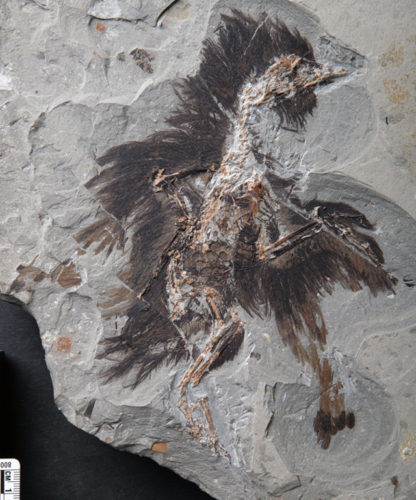
Eoconfuciusornis zhengi (Photo courtesy Dr. Xiaoli Wang)

An article published in the journal “Proceedings of the National Academy of Sciences” describes a research on a bird that lived about 130 million years ago called Eoconfuciusornis zhengi. A team of researchers from North Carolina State University, Chinese Academy of Sciences and Linyi University have found in this bird’s known fossil specimen traces of keratin and melanosomes and managed to prove that these are traces of its feathers.

Tongtianlong limosus skeleton (Image courtesy Junchang Lü et al.)

An article published in the journal “Scientific Reports” describes the discovery of a new species of winged dinosaur that was named Tongtianlong limosus. The specimen studied was found in the Nanxiong Formation, in the Guangdong province, in south-eastern China, where it lived between 66 and 72 million years ago, at the end of the Cretaceous period.

The region where Kaikaifilu hervei was found, its reconstruction and the area where the expedition worked (Image courtesy University of Chile)

An article published in the journal “Cretaceous Research” describes the discovery of a new species of mosasaur, a family of marine reptiles that lived in the Late Cretaceous. Called Kaikaifilu hervei, the animal found was probably long between 12 and 14 meters (39 to 46 feet). The fossils were found in 2010 by a Chilean expedition to Seymour Island in the Antarctic Peninsula in rocks dating back about 66 million years ago.

Fossil dinosaur brain (Photo courtesy Jamie Hiscocks)

A special publication of the Geological Society of London contains the results of a research into fossil dinosaur brain tissue that probably belonged to a species of the iguanodon group that lived about 133 million years ago. This fossil found more than a decade ago in Sussex by a fossil hunter is the first example of dinosaur fossil brain studied thanks to a research coordinated by Professor Martin Brasier of Oxford University and Dr. David Norman of the University of Cambridge.