
Technology

MS-DOS 6

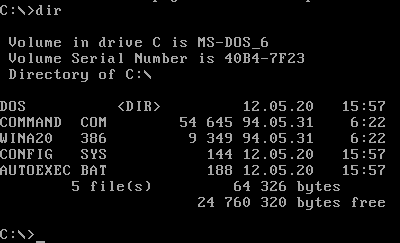
Microsoft has announced the release of the sources of versions 1.25 and 2.0 of its MS-DOS operating system, which were made available on the GitHub website, under the MIT free / open source license. In 2014 the same sources were released to the Computer History Museum but with a restrictive license, for historical reasons. The released versions are very old and Microsoft will not accept pull requests to modify them sent through the GitHub system but anyone can freely not only read the assembly code but also experiment with it, perhaps on a virtual machine.

Some of Walney Extension's wind turbines (Photo courtesy Walney Extension)

A few days ago, the largest offshore wind farm off the Ireland coast has been inaugurated. Called Walney Extension, it’s a project of Danish company Ørsted capable of generating up to 659 MWatts to supply electricity for over 590,000 homes. This wind farm broke the record of another British farm, the London Array, which can generate up to 630 MWatts.

Mouse brain cells

An article published in the journal “Nature Communications” describes a new technology developed to obtain highly detailed images at very small scales of what happens inside living cells. A team of researchers combined the use of heavy water as a tracer with the technique known as stimulated Raman scattering to be able to obtain images of metabolic activities. The idea is to use it for medical purposes, completing other exams, and biological research.

The DJI Inspire 1 Quadcopter (Image courtesy DJI. All rights reserved)

The Mexican city of Ensenada has become famous in recent days because the local police declared that they have been able to arrest over 500 criminals thanks to the use of a drone in the last 4 months. According to the statistics reported, that led to an overall crime reduction by 10% overall and in particular a drop in burglaries by 30%.

A view of Summit (Photo ORNL)

IBM and the US Department of Energy’s Oak Ridge National Laboratory (ORNL) announced the supercomputer Summit stating that it’s the fastest in the world. Peak performances are declared at 200 petaflops, which are eight times those of the previous ORNL supercomputer, called Titan, activated in October 2012 and for a few months the most powerful in its category. It’s a system designed for scientific applications with an eye to artificial intelligence.