Dinosaurs

The changes in the brain of Psittacosaurus lujiatunensis in the transition from quadruped to biped

An article published in the journal “PeerJ” reports a study on the development of the skull structure of Psittacosaurus lujiatunensis during its growth. A team led by Claire Bullar of the British University of Bristol examined dozens of fossils belonging to this species focusing in particular on their skulls to understand their growth. This also offers more information on their locomotion changes since they were born quadrupeds but were bipeds in adulthood.

Hesperornithoides miessleri was a feathered dinosaur that lived 150 million years ago

An article published in the journal “PeerJ” reports the identification of a new species of feathered dinosaur dating back to about 150 million years ago, in the Late Jurassic period, in today’s Wyoming, USA. A team of paleontologists named it Hesperornithoides miessleri and classified it in the troodontid family, dinosaurs with various characteristics similar to birds. This species seems to be a primitive member of that group, an unusual discovery that raises new questions about the timeline of the evolution of birds and of flight in other dinosaurs belonging to groups that got extinct.

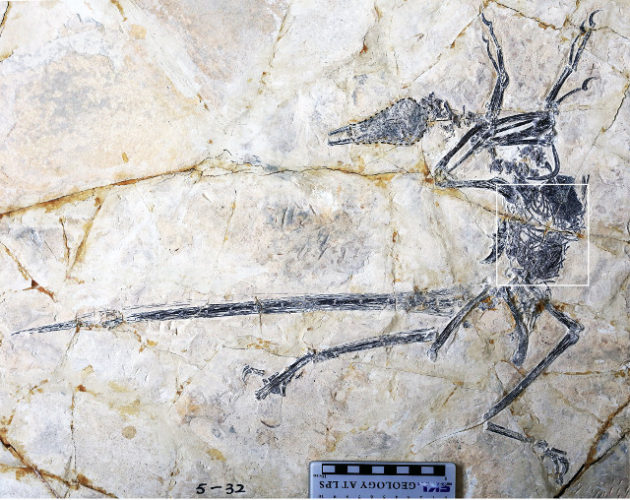
A feathered dinosaur of the species Microraptor zhaoianus discovered with an almost complete lizard in its stomach

An article published in the journal “Current Biology” reports the study of a specimen of a small feathered dinosaur belonging to the species Microraptor zhaoianus which is not only almost complete but still contained in its stomach the remains of a lizard belonging to a species that was still unknown and was named Indrasaurus wangi. A team of paleontologists led by Professor Jingmai O’Connor of the Chinese Academy of Sciences examined the remains of the two animals that lived about 120 million years ago in today’s China and, also based on three previous discoveries of Microraptor with a preserved prey in their stomach, confirmed the theory that this type of dinosaur was an opportunistic predator.

New clues that the origin of plumage goes back to at least 250 million years ago

An article published in the journal “Trends in Ecology & Evolution” reports new clues about the origin of plumage that confirm that it evolved starting from about 250 million years ago among some life forms that survived the devastating mass extinction that occurred at the end of Permian period. A team of researchers coordinated by the British University of Bristol combined information regarding fossils with others obtained through molecular biology analysis to obtain a conclusion that confirms a hypothesis made after the discovery of feathered pterosaurs.

Phuwiangvenator yaemniyomi and Vayuraptor nongbualamphuensis were two distant relatives of T.rex

An article published in the journal “Acta Palaeontologica Polonica” reports the identification of two new species of dinosaurs that lived in present-day Thailand, in the Sao Khua Formation, in the Lower Cretaceous period, about 125 million years ago. A team of researchers named the two species Phuwiangvenator yaemniyomi and Vayuraptor nongbualamphuensis, classified in the group of coelurosaurs, distant relatives of the T.rex even if with more primitive physical structures but good enough to make them efficient predators too.