Evolution

Fossil skin fragments

An article published in the journal “Nature Communications” describes a research on the skin of feathered dinosaurs. A team of researchers examined fragments of fossil skin of specimens of some species discovered in north-eastern China: Microraptor, Beipiaosaurus and Sinornithosaurus together with an early bird of the genus Confuciusornis. The conclusion is that those dinosaurs shed their skin in tiny flakes, like modern birds, and not all together like many modern reptiles.

Marsarchaeota

An article published in the journal “Nature Microbiology” reports the discovery of a new group of archaea that was called Marsarchaeota. A team of microbiologists from Montana State University (MSU) discovered these microbes in Yellowstone National Park, USA, in hot springs where temperature and acidity are high and the main mineral is iron oxide. Their discovery could offer new information on their evolution and in general on the origin of life on Earth and on the importance of iron in the early stages of its history.

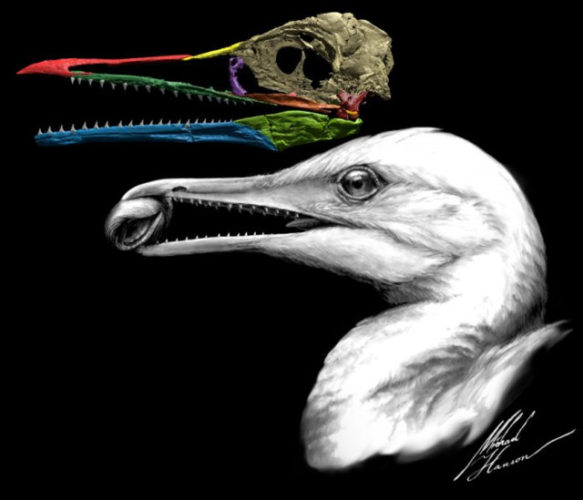
Fossil reconstruction and illustration of Ichthyornis dispar (Image courtesy Michael Hanson/Yale University. All rights reserved)

An article published in the journal “Nature” describes a research on the skull structure of Ichthyornis dispar, an ancient bird that lived almost 100 million years ago in North America. A team of researchers led by Yale University examined a complete skull and two pieces that were part of the first specimen of this species discovered in 1870 thanks to new technologies concluding that its characteristics represent a crucial moment in the evolution from dinosaurs to modern birds.

A possible moment during the Carnian Pluvial Episode (Image courtesy Davide Bonadonna. All rights reserved)

An article published in the journal “Nature Communications” describes a research on the link between the dinosaur diversification that took place at the end of the Triassic period and an event known as the Carnian Pluvial Episode, which occurred around 232-234 million years ago. According to a team of researchers, in the middle of that period of climate change, dinosaurs started thriving, evolving into many different species, also taking advantage of the extinction of other animals.

Bodo saltans infected by the virus

An article published in the journal “eLife” describes a research on a species of giant virus called Bodo saltans virus (BsV), considered part of the most abundant group present in the seas. The name is due to the fact that it infects a species of microscopic plankton called the Bodo saltans. A team of researchers from the University of British Columbia succeeded in isolating this virus, classified as a Klosneuvirus, a sub-group of the Mimiviridae family.