Evolution

3D reconstruction of fossil burrows (Image courtesy Luke Parry - University of Bristol)

An article published in the journal “Nature” describes the study of traces left by organisms that lived over half a billion years ago that could be important to understand how animals evolved. A team of researchers discovered fossil traces of tracks and burrows left by some of the first organisms capable of active movements. Those creatures were very small, with a thickness comparable to that of a hair that could range from 40 to 300 micrometres, but among them there could be the ancestors of most animals.

Chilesaurus diegosuarezi specimen

An article published in the journal “Biology Letters” describes a research on Chilesaurus diegosuarezi, a dinosaur that caused perplexity among paleontologists because it looked like a T.rex’s vegetarian cousin and had other characteristics that made it a kind of jigsaw puzzle of various species. According to Matthew Baron and Paul M. Barrett this dinosaur that lived in today’s Chile about 145 million years ago is a missing link that shows how carnivorous theropods have evolved into herbivorous long-necked ornithischians.

Male and female of common house spider

An article published in the journal “BMC Biology” describes a genetic research that shows a whole genome duplication (WGD) during the evolution of arachnids. An international team of researchers in collaboration with the Human Genome Sequencing Center at Baylor College of Medicine analyzed the DNA of the common house spider (Parasteatoda tepidariorum) and the Arizona bark scorpion, Centruroides sculpturatus, concluding that they descended from a common ancestor that lived more than 450 million years ago.

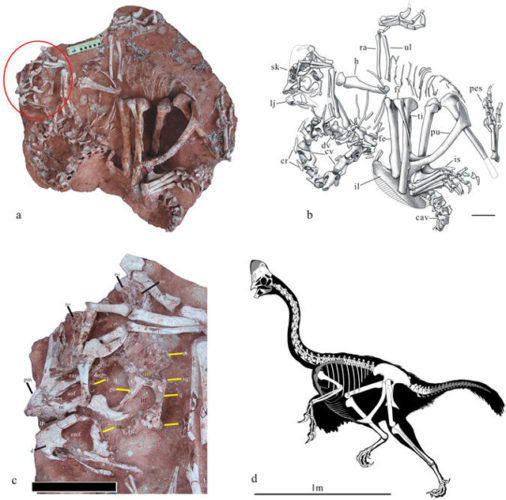
Corythoraptor jacobsi's fossils and drawings (Image courtesy Lü Junchang et al.)

An article published in the magazine “Scientific Reports” describes a research on a feathered dinosaur that shows not the usual generic similarities to birds but a remarkable resemblance to the cassowary with a crest on its head and long legs. A team of paleontologists led by Lü Junchang called it Corythoraptor jacobsi and it was a dinosaur belonging to the oviraptorid family that lived in the late Cretaceous, between 100 and 66 million years ago, in today’s southern China.

Scheme of the genetic research on birds (Image courtesy Koji Tamura (Tohoku University), Ryohei Seki (National Institute of Genetics), and Naoki Irie (University of Tokyo))

An article published in the journal “Nature Communications” describes a research showing a possible genetic mechanism that determined the evolution of birds from dinosaurs. A team of researchers from the Japanese Tohoku University that includes international collaborators provided what the scientists believe are evidence of the connection of certain genetic sequences to the evolution of bird traits such as feathers.