Software

Researcher Risa Nishiyama with Pepper robot using IBM Watson during a demonstration

IBM and SoftBank Telecom Corp., a subsidiary of SoftBank Corp, announced a deal to bring the cognitive computing system Watson to Japan. This collaboration will lead Watson to learn Japanese. Among the possible ways to interact with people there could also be a robot named Pepper.

It seems that IBM is trying to develop applications for Watson in all fields. The company is working even in the medical assisting doctors and researchers in the field of research and treatment of cancer. Its main uses are, however, in business, with various forms of assistance to employees and customers. The agreement with SoftBank goes in this direction.

The Supreme Court of the United States (SCOTUS) asked the Obama administration an opinion about the case of Oracle vs. Google in the case which for years has seen the two giants in a lawsuit about the use of the Java language in Android. The dispute began in 2010 after Oracle bought Sun, the company that developed Java, and claimed that Google violates copyright and patents related to Java. This isn’t one of the many clashes between companies regarding software patents but a special case where the final decision may have a significant influence on the future of software development.

Samsung CEO Boo-Keun Yoon at CES 2015

In Las Vegas, at CES 2015, among the many new technologies, you can see a remarkable promotion of the so-called Internet of Things. Representatives of some of the most important technology companies made statements concerning the possibility to connect to the Internet your household appliances and other devices. According to their indications, home automation is no longer a niche for fans but will be in all homes.

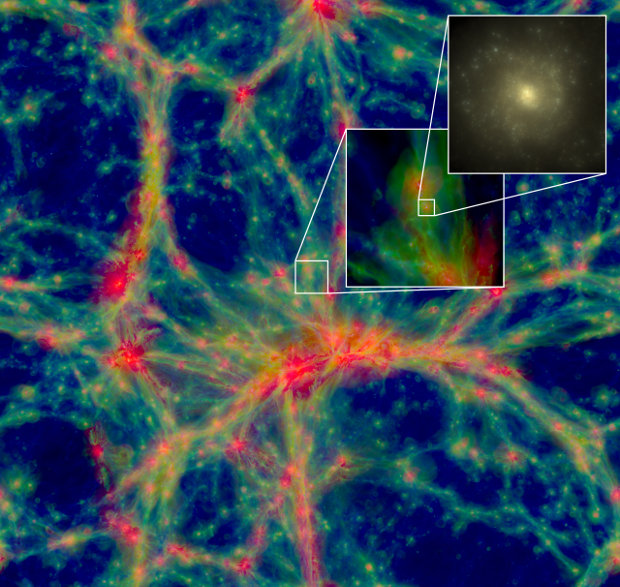
EAGLE image of the simulation of the history of a galaxy with some zooming (Image courtesy EAGLE project. All rights reserved)

A team of astronomers from the Dutch University of Leiden and the British one of Durham created a simulation of the universe called EAGLE (Evolution and Assembly of Galaxies and their Environments). This project is run by the Virgo Consortium which has exactly the aim to produce cosmological simulations using supercomputers. The result, published in the January 2015 edition of the journal “Monthly Notices from the Royal Astronomical Society”, reproduces faithfully the evolution of the galaxies from a very uniform starting point.