

Space probes

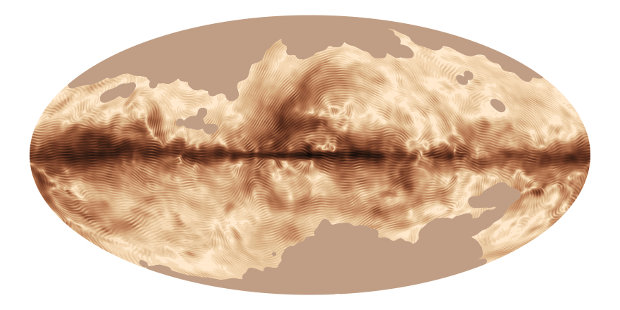
A map of the Milky Way magnetic field
The Planck space telescope completed its mission in October 2013 but in these cases the analysis of the data may continue for years. It’s for this reason that only now a map of the gravitational field of the Milky Way was published, an image compiled from the observation of the polarized light emitted by interstellar dust present in the galaxy.

Orbital Sciences and ATK merge to form a giant of aerospace industry
Aerospace companies Orbital Sciences Corporation, one of two private companies that have sent a spacecraft on the International Space Station, and Alliant Techsystems Inc., better known as ATK, announced they have reached an agreement for their merger. This operation will be preceded by an internal reorganization of ATK, which will be split to create a new company from ATK Sporting Group, the division that produces sport weapons. The other two divisions, ATK Aerospace Group and ATK Defense Group, together with Orbital Sciences will form Orbital ATK.


The Hubble Space Telescope will measure precise star distances 10 times farther into space
According to a saying you can’t teach an old dog new tricks. Clearly that’s not true for space telescopes because NASA announced that Hubble, in orbit since 1990, will now be able to accurately measure the distance of distant stars up to 10,000 light-years, ten times farther than was possible so far.

The LADEE space probe mission ended with its impact on the Moon
NASA has confirmed that the Lunar Atmosphere and Dust Environment Explorer (LADEE) space probe concluded its mission, which began in September 2013, crashing on the dark side of the Moon. This is the normal end of this type of missions as the purpose is to avoid that a probe might become a space wreck with the risk of it being drawn back to the Earth’s orbit causing potential dangers.
