Space probes

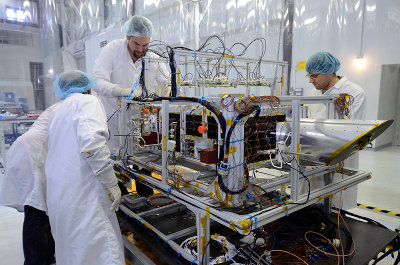
The NEOSSat satellite while being prepared for a test (Photo courtesy Janice Lang, DRDC)

A Polar Satellite Launch Vehicle (PSLV) rocket has just been launched from the Satish Dhawan Space Center on Sriharikota island, India. The cargo includes a series of small satellites including some nanosatellites such as the Surrey Training, Research and Nanosatellite Demonstrator (STRaND-1), based on a Google Nexus 1 smartphone running Android. Among the “real” satellites there’s the NEOSSat (the Near-Earth Object Surveillance Satellite). A little more than 20 minutes after the launch, the satellites have been deployed into orbit successfully.

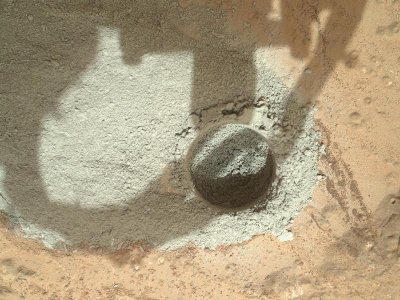
Ring of powdered rock produced by the Mars Rover Curiosity in its drill test (Photo ASA/JPL-Caltech/MSSS)

The Mars Rover Curiosity has been on Mars for several months but only now it made its first drilling test. For this test it used the drill mounted on its robotic arm to dig a hole in a rock named John Klein after an engineer of the project Curiosity who passed away in 2011.

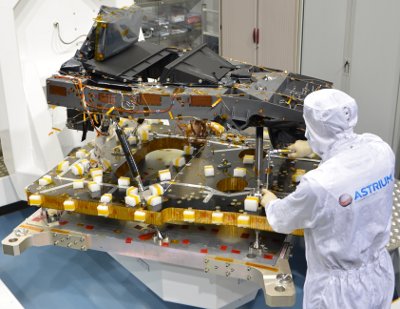
The TDRS-K satellite in a processing hangar before its launch (Photo NASA/Jim Grossmann)

A few hours ago the TDRS-K satellite was launched from Cape Canaveral and after a couple of hours it separated from the Centaur, the upper stage of the rocket, to enter geosynchronous orbit, where it will begin its work. The TDRS satellites are identified by a letter before becoming operational and by a number when they start working. Therefore, the TDRS-K satellite will become TDRS-11.