

Space probes


The effects of an immense storm on Saturn
The Cassini space probe has detected the consequences of an immense storm on Saturn almost two years after it had been spotted. Cassini discovered this rare storm in the northern hemisphere of the planet on December 5, 2010 and the observation went on for several months. In time, its visible signs disappeared but the composite infrared spectrometer (CIRS), one of the spacecraft’s instruments, showed that there are still effects from the storm.


Two new satellites were launched to test the Galileo system alternative to the GPS
Two satellites of the Galileo project were launched into orbit yesterday when in Europe it was evening from French Guiana using a Soyuz ST-B rocket. The two satellites are part of the Galileo project, an alternative to GPS created by the European Union, of which they represent an important step because the first two satellites had been launched into orbit on October 21, 2011 and four is the minimum number to have a constellation and test the system.

Has the Voyager 1 space probe reached interstellar space?

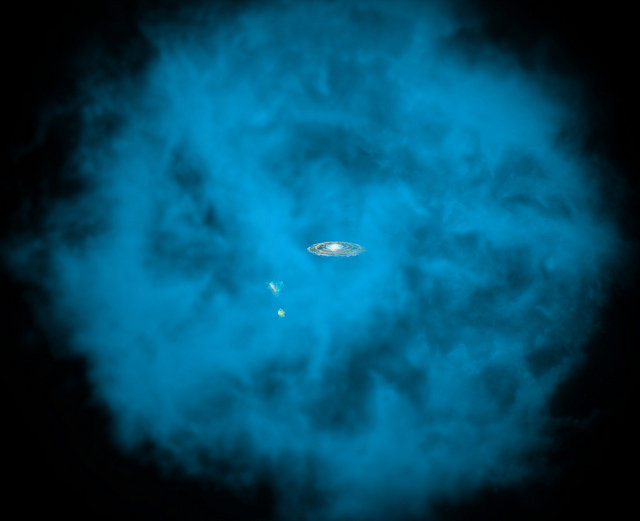
A huge hot gas halo around the Milky Way
A team of astronomers used NASA’s Chandra X-ray Observatory to find evidence that the Milky Way is wrapped in an enormous halo of gas that has a radius of at least 300,000 light years but it could be much bigger. The size of this halo is therefore so big that it includes the Large and Small Magellanic Clouds, two small galaxies near – of course in astronomical terms – the Milky Way.
