
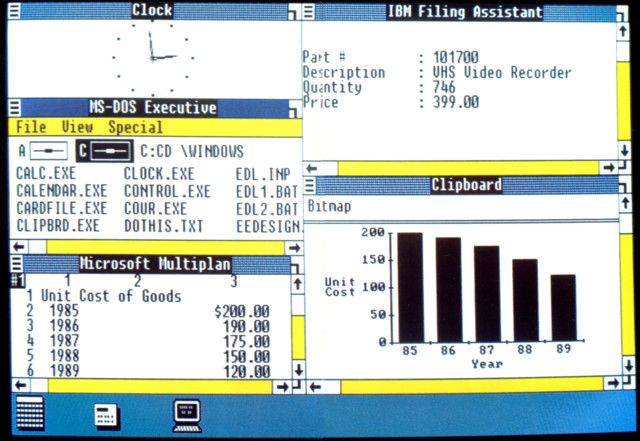
On November 20, 1985, Microsoft Windows 1.0 (screenshot ©Microsoft) was launched on the market, and according to many people, its new versions keep on claiming victims. 😀
Windows creation started at the beginning of the ’80s with the production of a graphic interface that was actually a program for the MS-DOS operating system using concepts inspired to the ones developed some years before by Xerox.
Since the beginning, Windows has included various programs still present today, the game Reversi included, but with various limitations due to early ’80s PCs’ hardware features.
Windows 1.0 wasn’t exactly a great success, and in 1987 Windows 2.0 was launched with a more sophisticated graphic interface and the possibility to use expanded memory. Windows 2.1 was released later also in a Windows/386 version that, though still an interface running over MS-DOS, could use the then advanced 80386 CPU freatures and extended memory.
Meanwhile, Microsoft was working with IBM on the OS/2 operating system with the intention of making it the MS-DOS successor. OS/2 1.1 had a graphic interface similar to Windows, then it was improved to become similar to the interface of what would become Windows 3.1.
At that point, Microsoft’s idea was to promote the MS-DOS+Windows couple as a bridge system to move to OS/2 through the years and in 1990, the new Windows 3.0 started being offered as a preinstalled software on new PCs.
Windows 3.0’s success was so great that Microsoft decided to stop its partnership with IBM for the development of OS/2 to keep on developing Windows instead. On one side the natural development of this operating environment led in 1992 to the launch of Windows 3.1, on the other side some parts of the OS/2 project were given to another team that had already developed the VMS operating system to create what in 1993 would become the first version of the Windows NT family though it was released as 3.1 to match the other branch version.
Windows NT was a real operating system with features much superior to the MS-DOS+Windows 3.1 duo but it needed huge hardware resources that cost various thousands of US dollars so, even if it had a business target, the Windows NT family growth was very slow.
Microsoft kept on developing what had become the Windows consumer version, turning it into a true operating system merging MS-DOS and the old operating environment creating Windows 95. This development went on with Windows 98, Windows 98 Second Edition, and ended with its last update, which was called Windows Millennium.
The Windows NT family kept on being developed as well, and at a certain point, it was decided to abandon the old version numbering, so Windows 2000 was released.
Hardware development and the consequent price fall allowed the NT family to enter all houses, so in 2001, Windows XP was released. The adoption of this new operating system wasn’t so easy because of its great security issues: the growing spread of the Internet exposed the users who adopted Windows XP, sometimes just because it was preinstalled on a new PC, to malware attacks at a scale never seen before and it took a couple of years before Microsoft was able to make it reasonably secure.
To avoid new security issues like in Windows XP, also because of the strong position Linux has conquered in the server market, Microsoft developed the successor Windows Vista with great attention to protections. The result though, was annoying for users, also because of the introduction of technologies aimed at restricting the copying of protected digital media, which made the use of Windows Vista even more complex. The addition of great hardware requests made Vista one of the greatest Microsoft busts, creating the concept of “downgrade” as many users who bought a new PC with a preinstalled Windows Vista preferred to downgrade it to Windows XP.
During the following years, Microsoft worked to make Windows more usable without increasing hardware requirements, and in 2009, Windows 7 was released.
What’s the future of Windows? Microsoft got us used to quite precise expectations: for each new Windows version, various new features are promised, but for ten of them, three are actually completely included, three more are only partially included, and the inclusion of the remaining four is postponed to a following version. Each new version is released much later than the first announced date anyway, typically even serious issues are discovered, and it can take even months to fix them, sometimes only partially.
Microsoft’s production style was made easier because it had had a monopoly on consumer operating systems for years, but the new Apple drive and the slow but continuous growth of Linux, which anyone can easily install on their PCs in half an hour, in the desktop field is forcing Bill Gates’ company to work harder to improve Windows quality.
For better or for worse (many would say especially for worse!) Windows left a deep mark (scar?) in PC’s history. In fact, today users have an approach to the use of a PC that started thanks to Windows: in what in information technology was an eon ago, people needed to make some use of their brains, while today clicking some icons is enough, and if it gets them some malware, they format it. Yes, because Windows taught us that formatting is the solution for every problem.
