
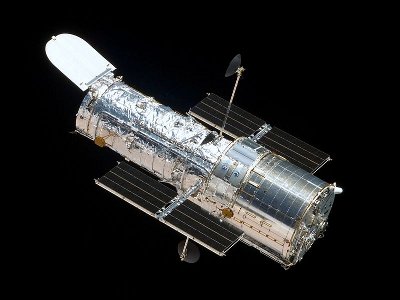
The National Reconnaissance Office (NRO), an intelligence service of the U.S.A. whose specific purpose is to design, build, and manage American spy satellites, has donated two spy telescopes to NASA. It seems that the NRO contacted NASA last year to see if there was a chance for the two satellites to be turned into scientific instruments instead of being dismantled.
The information on these two spy satellites is obviously incomplete, and we can’t expect the NRO to let us know exactly which instruments were installed on them and how they were used. What we do know is that they are more or less the size of the Hubble Space Telescope; they have a 2.4-meter (7.9-foot) mirror like Hubble, but they also have a secondary mirror that makes them much more powerful.
These two spy satellites have no instruments such as cameras, so for them to be sent into space and be used as telescopes, some work to complete them would be needed. Unfortunately, NASA’s budget is what it is; therefore, currently there’s no money for a space mission to prepare and make at least one of the two orbiting satellites.
One idea would be to use one of the two satellites for the Wide Field Infrared Survey Telescope (WFIRST) mission, a NASA project to search for exoplanets and to study dark energy. Because of budget problems, the launch of this telescope is planned for the next decade without a precise schedule.
Having the possibility to use an existing satellite that can be reused as a space telescope would significantly reduce the costs and shorten the timeline because building a space telescope takes years.
Waiting to see if NASA manages to use the two former spy satellites, I can’t help making a few comments on the fact that the NRO can afford to donate instruments more powerful than the Hubble Space Telescope as if they were old junk. I can’t help wondering what kind of spy satellites are now used by the NRO.
A group of nations is struggling to provide the budget necessary to build the James Webb Space Telescope, while the NRO can afford to spend maybe even more to be able to read from orbit the texts of the SMSs that people send or read outdoors. Obviously, only a few people have access to that kind of information and know if they have to respond to anyone, because lately it seems that no one watches the watchers.

Permalink