
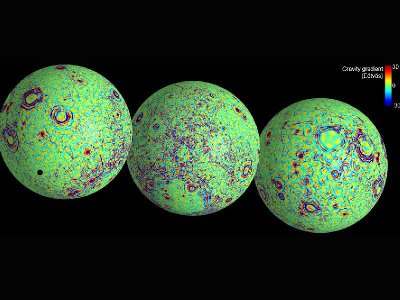
Ebb and Flow, the GRAIL (Gravity Recovery And Interior Laboratory) twin spacecraft are about to end their mission and in the meantime NASA released the first results of their very precise measurements of the Moon gravitational field.
The obtained map is allowing scientists to expand their knowledge of the Moon because the very small variations in its gravity were used to map the features of its internal structure and its composition. In fact, they highlighted its tectonic and volcanic, its basins and the various elements of its craters.
This mission has also allowed the measurement of the lunar crust thickness, an problem that has been open for decades. The data obtained during the Apollo program had led to the suggestion that the lunar crust wasn’t as thick as it was generally thought but the end of the missions to the Moon had prevented further direct measurements. The data from the GRAIL spacecraft have now established that the average thickness of the lunar crust is between 34 and 43 km (from 21 to 27 miles), 10-20 km (6-12 miles) less than expected and in agreement with the data obtained during the Apollo program.
An important confirmation is the one concerning the density of the lunar crust, similar to that of the Earth. This confirms the theory of the Moon origin occurred following the collision of a rogue planet with the primordial Earth, which threw in orbit a huge amount of materials that eventually coalesced to form the Moon.
Over the last few years there have been a number of simulations more and more sophisticated to precisely understand the dynamics of that primordial impact. According to a variant of this theory, the material thrown into orbit originally formed two moons which then merged because of their proximity.
[ad name=”AmazonScience”]
As expected, Ebb and Flow are running out of propellant and on December 17 they’re expected to be guided to the lunar surface, where they’ll crash. It’s a sad end but it’s the cleanest way to end the mission of the probes that can’t be further used and prevent them from turning into potentially dangerous space debris.
The GRAIL mission lasted less than a year but the amount of data obtained from the two spacecraft is really huge. The results recently released are in fact only the first product of their analysis but in recent months Ebb and Flow have accomplished their extended mission at a reduced hight, that in the last days was only at and average of 11 km (almost 7 miles), sending to Earth even more accurate data. Therefore, we can expect new information on the composition and evolution of the Moon that – let’s always remember it – is closely linked to that of the Earth.

Permalink
Permalink