
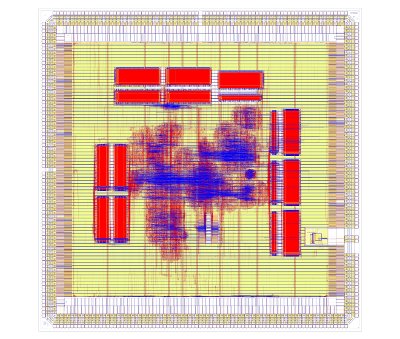
Not only human beings can have problems during space missions because of the radiations but also electronic equipment may suffer malfunctioning. For this reason, there are microprocessors designed specifically to work in those conditions. Since the ’90s, ESA plans microprocessors starting from existing designs and adapting them to be used in space missions. Today ESA uses microprocessors of the LEON series.
The LEON project began in 1997 and is based on the RISC SPARC-V8 32-bit architecture and instruction set. One of the purposes is to produce microprocessors capable of correcting errors caused by ions or electromagnetic radiation, normal events in the upper areas of the Earth’s atmosphere and in space. A reduced version of the LEON project was released as open source.
Microprocessors can be physically shielded to protect them from radiation and ions but this solution doesn’t work 100%. Some bits may still be altered so it’s necessary to implement correction technologies that ensure thath they work properly.
In 2008 the LEON2-FT microprocessor was produced. The abbreviation FT means “fault tolerance” and indicates precisely its ability to correct errors caused by space radiation. Commercially, it’s known as the AT697. Its first application was in the Columbus module of the International Space Station in the prototype of a computer called ERNObox. In 2009, a LEON2-FT microprocessor was used to run the flight computer of the ESA microsatellite Proba-2. Both of them are still working, confirming their design’s validity.
New satellites such as the Galileo constellation are using the LEON3 microprocessors, the new generation that introduced support for multiple cores. It’s also become the basis for the SCOC3 (spacecraft-computer-on-a-chip), already used for the French satellite Spot-6.
In the future, the Next Generation Microprocessor (NGMP) will be based on the LEON4, a further evolution that has four cores and even greater performance. That doesn’t mean that the previous microprocessors will no longer be used: on the contrary, the use of processors LEON2-FT is for example scheduled in various missions of the next few years, including the BepiColombo space probe to Mercury.
The great development work carried out by ESA over the years is useful to be independent from non-European suppliers. The availability of microprocessors and their development to avoid the risk of being left behind are key factors in the technological field, even more where every day they try to exceed the limits of what they can do. Once again, ESA shows it wants to be a very high profile organization.
[ad name=”Google Adsense 300″]
