

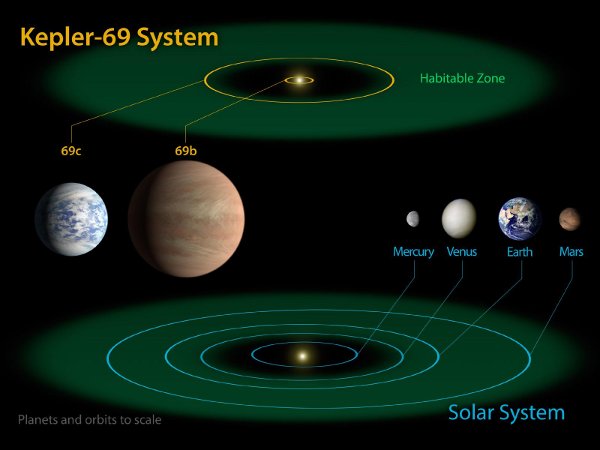
Thanks to NASA’s Kepler space telescope it’s been discovered that the star Kepler-62, approximately 1,200 light-years from the Sun, has five planets and the star Kepler-69, approximately 2,700 light-years from the Sun, has two planets. The most interesting news is that two of Kepler-62 planets and one of Kepler-69 planets are probably of the rocky type and their orbit is within the habitable zone of those solar systems.
The star Kepler-62 belongs to the spectral class K2 and has a mass that is approximately 69% of the Sun. It’s older than the Sun since its age is estimated at around 7 billion years, but due to its mass it consumes hydrogen much more slowly than the Sun therefore it still has several billion years of life ahead of it.
Because Kepler-62 is smaller than the Sun, it emits less light of our star, so its habitable zone is closer to it. The closest planet, Kepler-62b, is slightly larger than Earth and orbit its star in less than 5 days. The second, Kepler-62c, has a size similar to Mars and orbits its star in just over 12 days. The third, Kepler-62d has a size that is about twice the Earth and orbits its star in about 18 days.
These three planets are very close to the star Kepler-62 therefore the conditions on their surfaces are expected to be similar to those on Mercury. The other two planets are far more interesting due to their characteristics and their position within the habitable zone of that solar system.
[ad name=”AmazonDocumentary”]
The planet Kepler-62e has a radius which is approximately 1.6 times that of Earth, it probably has a solid surface and orbits its star in about 122 days. According to a study accepted by “The Astrophysical Journal”, the surface of this planet could be completely covered by an ocean.
The last planet, Kepler-62f, has a radius which is approximately 1.4 times that of Earth, it probably has a solid surface and orbits its star in about 267 days. It may be covered by an ocean as well but it could be frozen. Due to its distance from its star, the temperature on the surface depends upon its weather conditions, which have yet to be evaluated.
The star Kepler-69 is very similar to the Sun in mass and luminosity. The planet Kepler-69b is about twice as large the Earth and orbits its star in just 13 days so the conditions on its surface are worse than those on Mercury.
The planet Kepler-69c is interesting because it’s at the limits of the habitable zone of its solar system. Its radius is about 1.5 times that of Earth and orbits its star in about 242 days. Its position is very similar to that of Venus therefore it’s potentially habitable but it could have a greenhouse effect as that of Venus which would make it too hot.
These planets are certainly interesting and will be studied with other instruments in order to better understand their characteristics. Some comments about their discovery have been overly enthusiastic calling them Earth’s twins. Actually, we still know too little to say if they’re truly habitable but their discovery confirms that in time more and more Earth-like planets are discovered.

Permalink
Permalink