
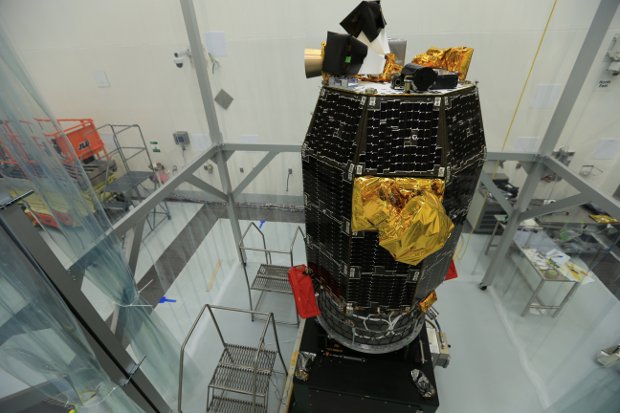
A few hours ago, the Lunar Atmosphere and Dust Environment Explorer (LADEE) space probe was successfully launched on a Minotaur V rocket from the Mid-Atlantic Regional Spaceport (MARS), part of NASA’s Wallops Flight Facility (WFF) on Wallops Island, Virginia. Its purpose is to study the lunar atmosphere but also to test a very high speed laser communications system.
It was the first launch for the Minotaur V rocket, developed by Orbital Science Corporation. It’s an evolution of the Minotaur IV, a four-stage rocket already been used successfully for some launches of satellite into various orbits since 2010. Basically, the Minotaur V is a Minotaur IV with a fifth stage of Star 37 type already used for many years.
Orbital Science has developed Minotaur rockets as an evolution of the technology of the LGM-118 Peacekeeper ICBM rockets, which were equipped with nuclear warheads. When international treaties led to the deactivation of the Peacekeepers, Orbital Science started converting them into launchers adding a fourth stage of the Star 48 type for the Minotaur IV or a fourth and a fifth stage for the Minotaur V. Obviously, they carry satellites or other space probes as a cargo instead of nuclear warheads.
The idea to study the Moon’s atmosphere may seem curious given that it’s almost non-existent but it’s virtually unknown. Knowing the atmosphere of other celestial bodies can also help us learn more about the Earth’s one. For example, studying the atmosphere of Venus, scientists understood the role of carbon dioxide as a greenhouse gas, an important factor in the recent discussions about global warming.
During the Apollo missions, the astronauts noticed a glow over the Moon’s horizon at sunrise. It’s possible that it was caused by dust electrically charged by sunlight but no one had ever tried to verify this. This is one of the purposes of the LADEE probe, which in general will analyze the composition of the lunar atmosphere.
[ad name=”AmazonScience”]
The LADEE spacecraft is also equipped with the Lunar Laser Com Demo (LLCD), a laser communication system that allows to transmit and receive data through light pulses. With more and more congested radio frequencies, NASA is developing laser systems, which among other benefits allow to transmit data at speeds up to five times higher than those reached by radio.
The LADEE space probe was built using the Modular Common Spacecraft Bus (MCSB) platform, a new design system. It aims to build space probes using certain predefined standards rather than design each probe from scratch. The advantage is significant with regard to the design time and especially the costs: clearly saving $100 million dollars if not more to build a probe is a big step forward.
Now the LADEE spacecraft is only at the beginning of a long phase of maneuvers that will go on for about a month and only at the end it will enter the Moon’s orbit and will start its mission. This is necessary to limit the amount of fuel required and the mission control center they’ll use the opportunity to do all the operational tests necessary and solve any possible problems.
For example, the gyroscopic system that uses reaction wheels set in motion a few hours after the launch seems to use more power than expected. Those are small problems that can happen with such complex equipment but there are no worries. The mission still started in a positive way.
NASA has already put online a video of the LADEE space probe launch

Permalink
Permalink
Permalink