
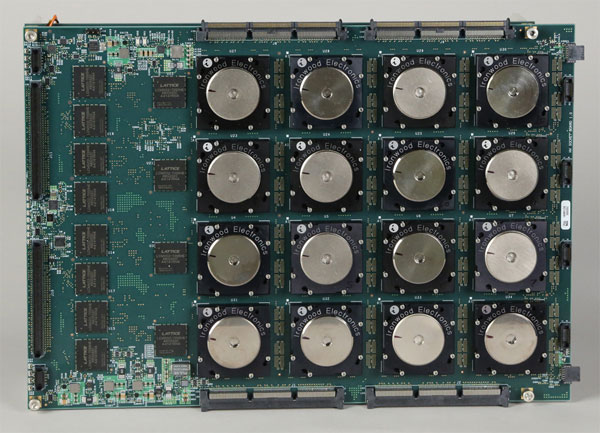
IBM has revealed its new neurosynaptic chip, which reproduces at least partially the brain’s synapses. It’s the culmination of six years of development in collaboration with DARPA in the SyNAPSE (Systems of Neuromorphic Adaptive Plastic Scalable Electronics) project. The chip called TrueNorth was produced with the 28nm process, contains 5.4 billion transistors and the innovative element is that it contains 4096 neurosynaptic cores with one million neurons and 256 million synapses but at the same time consumes only 70 mW during its operations.
Generally, chips are designed following a von Neumann architecture, named after John von Neumann, one of the fathers of computer science. The SyNAPSE project that led to the creation of the TrueNorth chip has instead used a parallel, distributed, modular, scalable, fault-tolerance and flexible architecture that integrates computation, communication and memory and doesn’t have a clock. In short, concepts that mimic the brain.
IBM worked with Samsung to develop the hardware solutions needed to create such an innovative chip. To use an electronic board with TrueNorth chips, it was also necessary to create a new software environment, an ecosystem different from the conventional ones with a new programming language which can exploit its potential.
IBM unveiled a 16-chip system, which has 16 million programmable neurons and 4 billion programmable synapses. The various chips can work together without problems and this lays the foundation for future neurosynaptic supercomputers. The next step for IBM will be builduing a 4,096-chip system with a total of a trillion programmable synapses which consumes 4 kW, very little compared to traditional supercomputers.
This approach, with the creation of artificial neurons and synapses, has the goal to create systems that are not only capable of operating at very high speeds using little power but also have the flexibility of a brain. There are several situations in which a computer must handle data from different sources, analyzing and integrating them in real time.
The complexity of certain operations can be handled much better by hardware similar to the structures of a brain. It’s for this reason that there are other projects which have the purpose of emulating an brain and IBM is always at the forefront. The SyNAPSE project still has much room for development so we can be sure that in the coming years chip more and more similar to brains will be unveiled.
[ad name=”AmazonComputerAndInternet”]

Permalink